
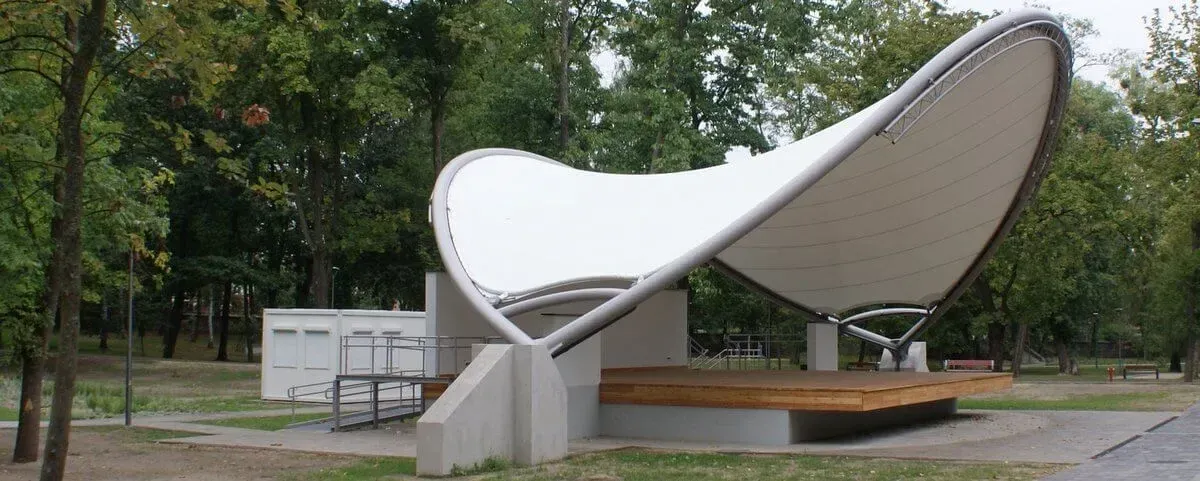
Membrane structures, despite their lightness and apparent fragility, can effectively withstand extreme weather conditions — provided they are properly designed and protected. With increasingly frequent weather anomalies, protecting these innovative structures from strong wind is becoming a priority for owners and designers.
How strong wind affects membrane structures
Wind interacts with architectural membranes in complex ways, generating loads in various directions. The most dangerous phenomenon is uplift, working on a principle similar to an aircraft wing — when air flows over the curved surface of the membrane, it generates lift force that can lead to damage.
Interestingly, properly designed membrane structures can show remarkable durability even during hurricanes. This happens thanks to their flexibility — unlike rigid structures, membranes can partially “cooperate” with the wind, dispersing its energy through controlled deformations.
In the context of progressing climate change, designing for extreme wind loads is becoming a necessity, not a luxury.
Key elements protecting membrane structures from wind
Effective wind protection starts at the design stage. Anchor points are a critical element of the entire system — they must transfer huge forces generated during storms. Properly placed wind braces and edge reinforcements prevent wind from getting under the membrane.
Equally important is appropriate material tensioning. A loose membrane is prone to flapping and water collection, while excessive tension can lead to damage during strong gusts. At Abastran we use advanced CFD (Computational Fluid Dynamics) analyses that allow simulation of structural behaviour in various wind conditions.
The shape of the structure is also a critical factor. Streamlined forms significantly reduce air resistance, while sharp edges can generate turbulence increasing loads. Our designers use experience gained from projects in the windiest locations to create structures that work harmoniously with the forces of nature.
Materials resistant to extreme weather
In the context of wind protection, choosing the right membrane material is fundamental. Membranes from PTFE fabrication show exceptional tensile strength and resistance to extreme weather conditions. Their durability reaches 30 years, making them ideal for long-term applications.
Alternatively, PVC membranes processed by professional PVC welding offer an excellent strength-to-cost ratio. Advanced material joining technologies ensure that the seams are as strong as the membrane itself, eliminating potential weak points.
The methods of joining individual elements also drive safety. At Abastran we use high-frequency welding technology and precision fixing systems that guarantee structural integrity even under the strongest wind gusts.
Properly protecting a membrane structure against extreme wind conditions requires specialist knowledge and experience. As experts in designing and delivering advanced membrane structures, we offer comprehensive solutions tailored to specific site conditions and owner requirements. Contact us to learn how we can protect your structure against even the most extreme weather conditions.