
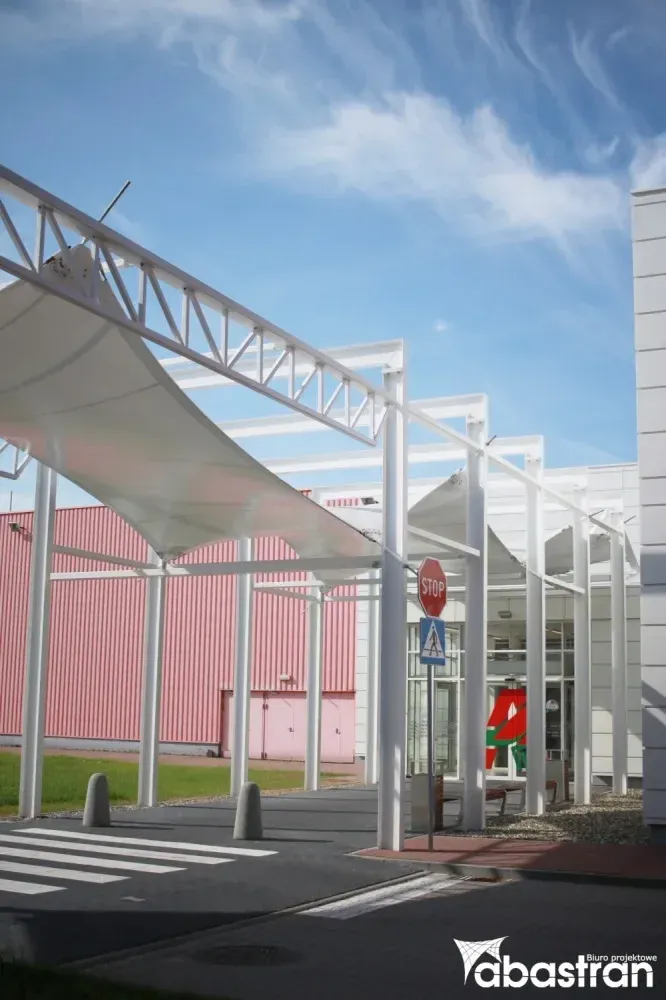
The demand for advanced steel structures has been growing dynamically in recent years, reflecting the increasing importance of this sector in modern construction. Steel structure design is a complex process that requires not only engineering knowledge but also the ability to combine technical and economic considerations. This is particularly visible in specialised projects like tensile membrane structures, ETFE structures and tent halls, where the traditional design approach has to be adapted.
The key to success in steel structure design is an integrated approach that addresses not only the conceptual phase but also production and assembly aspects. Experience from complex projects — large-area canopies, pneumatic halls — shows that early collaboration between design teams and production/assembly departments helps avoid costly mistakes and optimise the overall investment process. This article walks through the comprehensive design approach, drawing on years of practical experience and the latest technology trends.
The design process phases
Professional steel structure design is a multi-phase process that requires systematic approach and deep knowledge of both technical and regulatory aspects. Regardless of the structure type — classical steel halls or specialised membrane structures — the design process splits into five key phases that determine project success.
Phase 1 — requirements analysis and concept
The first phase is requirements analysis and concept development. Here we gather information on the building’s intended use, site conditions, owner expectations and budget constraints. Identifying ground conditions, climate and environmental loads is also critical. According to Eurocode 3 (PN-EN 1993), the consequence class and associated reliability requirements are defined at this stage. Inadequate initial analysis frequently leads to costly changes later in the project, which is why careful analysis of all factors is so important.
Phase 2 — modelling and analysis
The second phase is modelling and structural analysis. Specialist engineering software is used to create a calculation model that includes all major load-bearing elements and their connections. Static and dynamic analysis verifies the structural behaviour under various load combinations according to PN-EN 1990 and PN-EN 1991. For specialised structures like membrane canopies or pneumatic halls, advanced nonlinear analyses are essential — taking into account material and geometric specifics. Verification of the calculation model is critical at this stage — even the most accurate calculations cannot compensate for errors in the initial assumptions.
Phase 3 — structural element sizing
The third phase is sizing of structural elements and connections. Based on the analysis results, appropriate steel cross-sections are selected and connections between them are designed. The process must comply with Eurocode 3, addressing ultimate and serviceability limit states. Connections deserve particular attention — they are often the weakest links in the structure. Our practice uses a 30/70 rule: 30% of design time on concept and analysis, 70% on optimisation and detailed sizing of elements and connections. This approach helps avoid problems during construction.
Phase 4 — fabrication documentation
The fourth phase is preparing fabrication documentation. This includes detailed shop drawings, material specifications and assembly instructions. The documentation must comply with EN 1090 requirements, which define execution classes for steel structures. For specialised structures like tent hall covers or flexible tanks, fabrication documentation must address specific production technologies, including PVC welding requirements. Verifying design assumptions against production capabilities at the concept stage helps avoid situations where designed elements are impossible to fabricate.
Phase 5 — site supervision and contractor collaboration
The final phase is design supervision and contractor collaboration. Even the best documentation requires interpretation and adaptation to site conditions. As designers we actively participate in execution, solving problems as they arise and verifying that fabrication matches the design. For unusual structures, our presence during key assembly phases is essential to ensure safety and function.
Steel structure optimisation
Steel structure optimisation goes far beyond simple material savings. The modern approach addresses the entire lifecycle of the structure — material and production costs, assembly time and ease, operation, and eventual decommissioning. For specialised structures, optimisation becomes a critical part of the design process.
Mass reduction is the classical aspect of optimisation, with direct impact on material and transport costs. Modern topology optimisation methods help identify and eliminate unnecessary material while maintaining required load capacity and stiffness. Sensitivity analysis to changes in material parameters helps determine which structural elements are critical to safety and which can be optimised.
Section selection should address not only strength requirements but also production and economic considerations. Using standard profiles available without special ordering can significantly lower costs and lead times. For structures with high aesthetic or functional requirements, special profiles can deliver better properties at lower mass. Section selection should also address production technology — some profiles are easier to machine or weld, lowering fabrication costs.
Connection optimisation is often overlooked but critically important. Different connection methods (welded, bolted, riveted) have different cost, time and quality control characteristics. For temporary structures like stage canopies or advertising tents, demountable connections allow fast assembly and disassembly. For permanent structures like industrial halls or tanks, welded connections can deliver better integrity and durability.
In summary
Steel structure design is a dynamically developing field that combines traditional engineering knowledge with modern technology and optimisation methods. The comprehensive approach — addressing the entire structure lifecycle from concept through production and assembly to operation — produces buildings that combine function, safety and economic efficiency. For specialised structures like canopies or ETFE structures, integrating different areas of knowledge and experience is the key to success.
At Abastran we specialise in advanced structure design and delivery. Our experience in optimisation lets us deliver solutions that are safe, functional and economically justified. Close collaboration between design and production departments lets us deliver even the most demanding projects at the highest quality standards.
If you are planning a project that needs advanced structural solutions, contact us — our experienced design team will help you find the optimal solution for your needs.