
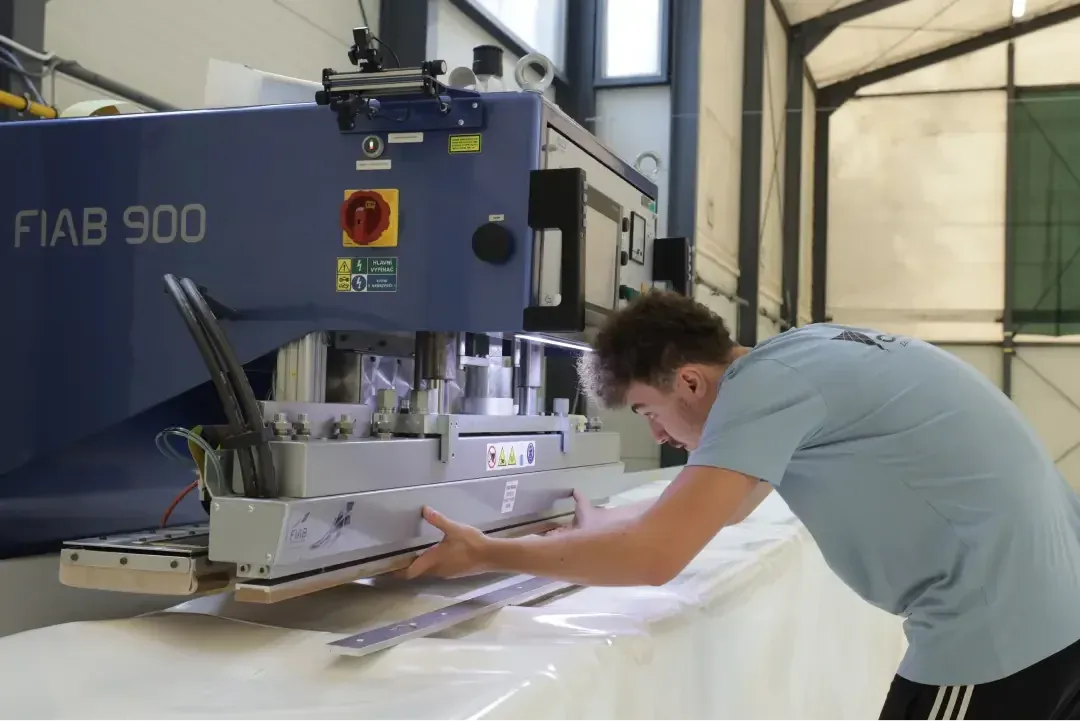
Plastic welding is a critical technology across many industrial sectors, and the choice of method has significant impact on the durability and performance of the finished product. The two most common materials in technical fabric welding are PVC (polyvinyl chloride) and PTFE (polytetrafluoroethylene). Each has distinctive properties that may suit one project better than another. This article walks through a detailed comparison of PVC and PTFE welding technologies, covering their applications, strengths, weaknesses, and the situations where each is the right answer.
What is PVC welding?
PVC welding is the process of joining polyvinyl chloride sheets using heat and pressure. PVC is a popular material in industrial fabrication because of its mechanical strength and chemical resistance. PVC welding is commonly done using high-frequency (HF) welding, impulse welding, or hot-plate welding. Each method gives durable, watertight joints with characteristic strengths.
PVC applications include film production, packaging, furniture, sealing systems in construction, and many chemical industry applications where its resistance to a wide range of chemicals is critical.
Advantages of PVC welding
- Chemical resistance — PVC handles acids, bases and salts well, making it ideal for chemical industry applications
- Easy to form — PVC is relatively easy to shape and form, which enables fast and efficient welding processes
- Joint durability — PVC welds give long-lasting, mechanically strong bonds that hold up in challenging conditions
- Cost-effectiveness — PVC is significantly cheaper than alternative engineering plastics, which improves the overall economics of any production process
Disadvantages of PVC welding
- Temperature control — PVC welding requires precise temperature control. Excessive heat causes material degradation that lowers joint quality
- UV sensitivity — uncoated PVC is not naturally UV-resistant. Long-term sun exposure can cause yellowing and embrittlement (modern PVDF lacquers solve this)
- Limited elasticity — welded PVC can be less elastic than alternatives, which matters for some applications
What is PTFE welding?
PTFE welding joins polytetrafluoroethylene sheets using heat and pressure. PTFE is known for its exceptional chemical resistance and high melting point, which makes it the right choice for many specialised applications. The trade-off is that PTFE welding is significantly more demanding technically than PVC welding.
PTFE applications include aerospace, medical, chemical and energy industries — anywhere extreme temperature or chemical resistance is required.
Advantages of PTFE welding
- Exceptional chemical resistance — PTFE is essentially inert to most chemicals, making it ideal for the chemical industry
- High temperature resistance — PTFE handles temperatures that would destroy most engineering plastics, ideal for extreme thermal applications
- Low surface friction — PTFE has very low adhesion, making it easy to keep clean and ideal for low-friction applications
Disadvantages of PTFE welding
- Process complexity — PTFE welding requires specialist knowledge and precise process control, which raises production costs significantly
- Material cost — PTFE is much more expensive than PVC, which feeds through into total project cost
- Limited forming options — PTFE is harder to form than alternative plastics, which can limit its use on geometrically complex projects
Comparing the technologies
When you compare PVC and PTFE welding head to head, both have their place in industrial fabrication. PVC welding is much simpler and cheaper, which makes it the right choice for projects that need fast, economical solutions. PVC works particularly well for packaging, signage and applications with moderate chemical demands.
PTFE welding should be considered when the project requires resistance to extreme temperatures or aggressive chemicals. Although PTFE welding is more complex and expensive, its physico-chemical properties often outweigh those of PVC for the right application.
In summary
The choice between PVC and PTFE welding depends on the specific demands of the project. If you need a material with high mechanical strength, chemical resistance and thermal performance, PTFE welding is the right answer. If cost, ease of production and material availability are the priorities, PVC welding is the more economical option.
When in doubt, talk to an expert who can help you match the technology to the specific requirements of your project.
Get in touch
If you are weighing PVC versus PTFE welding for your project, contact the experts at Abastran. We specialise in PVC welding and PTFE fabrication and offer comprehensive consulting and services tailored to your needs. Click through and our team will help you specify the right technology and deliver your project at the highest quality.