
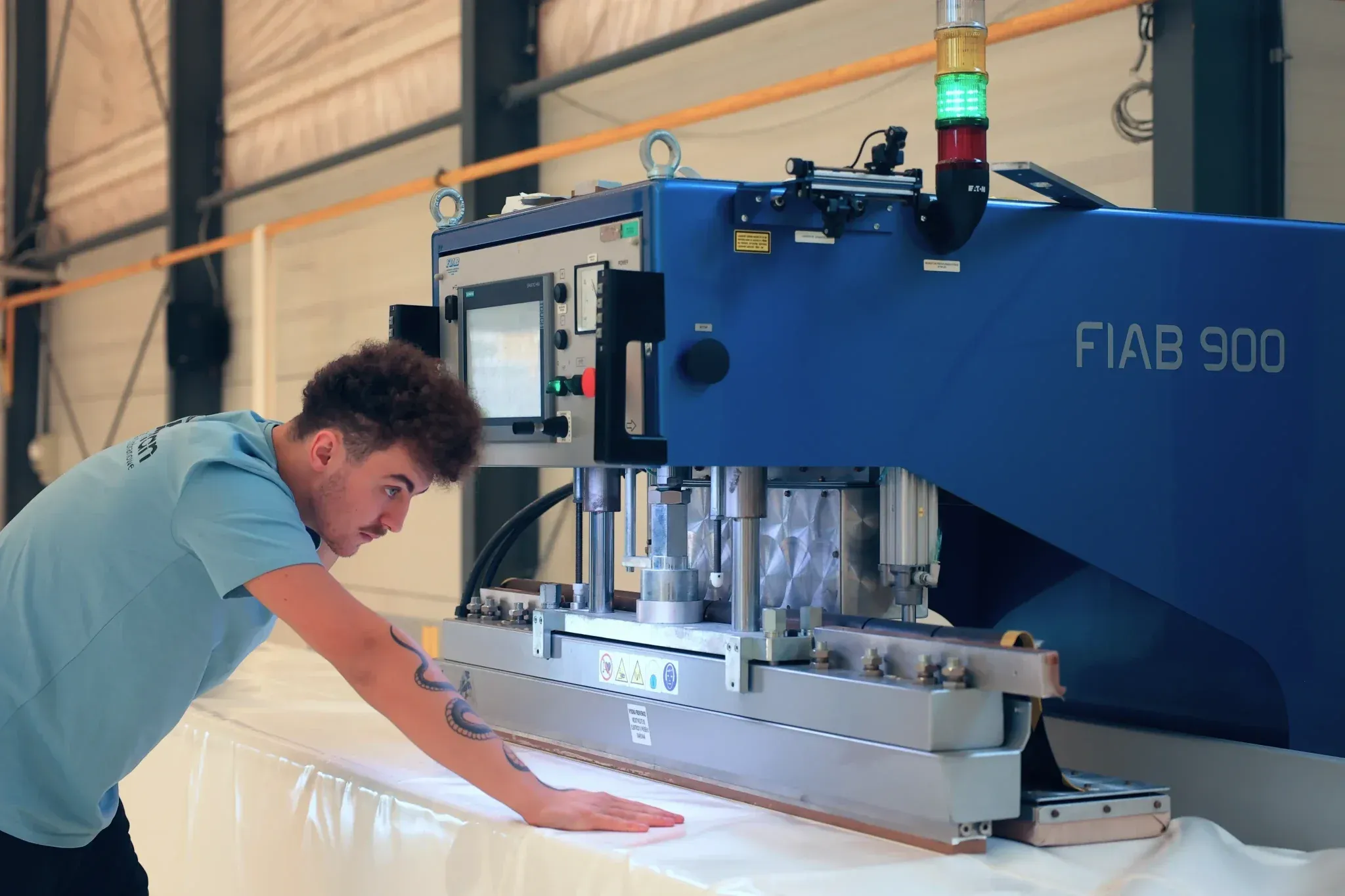
High-frequency PVC welding — usually shortened to “HF welding” or “RF welding” — is the technology that built the modern architectural membrane industry. It is fast, repeatable, and produces seams that are as strong and as watertight as the parent fabric. For PVC-coated polyester membrane fabrication, HF welding is not one option among many; it is the default.
What HF welding actually does
High-frequency welding uses an electromagnetic field — typically at 27.12 MHz — to heat the PVC layer of two membrane sheets from the inside. Under pressure from the welding electrodes, the heated PVC fuses across the joint. After a short cooling cycle, the joint is permanent: the two sheets become one continuous piece of fabric with no break in mechanical or barrier properties.
There are two things that make HF welding special:
- The heat is generated inside the material itself, not applied from outside. That gives clean, deep, repeatable bonds that do not depend on the operator’s skill at moving a hot iron at the right speed.
- No glue or solvent is needed. The bond is created by the PVC itself, which means there is nothing to fail and nothing to add to the production line.
Why it works for architectural membranes
Seam strength matches the fabric
A correctly tuned HF weld is as strong as the original fabric. That is the key claim, and it is what makes large-span tensile membrane structures possible. If the seam were the weak link, every panel join would limit the size and shape of the envelope.
Watertight by construction
There is no perforation, no thread, no glue line — just a continuous fused PVC surface. That is exactly what you want for a building envelope that has to keep rain out for 25 years.
Speed
Each weld cycle takes seconds. Production rates on a well-tuned line easily reach hundreds of metres per hour, which makes the economics of large architectural projects viable.
Precise, controllable parameters
Frequency, electrode pressure, weld time and cooling time are all controlled by the welding press. That repeatability is what lets a workshop produce hundreds of panels with identical quality — the foundation of any production-grade membrane process.
Where HF welding is used
Architectural membranes are the most visible application but not the only one. HF-welded PVC also shows up in:
- Tensile membrane structures, tent halls and shade sails
- ETFE pneumatic cushions (with different welding parameters than PVC)
- Inflatable structures including air-supported sports halls and event domes
- Geomembranes for water tanks, ponds and pollution control liners
- Industrial equipment — large bags, tarpaulins, conveyor curtains, cleanroom partitions
- Medical packaging — IV bags, blood bags, fluid containers
- Automotive interiors — door panels, headliners and trim
The same principle works across all of them: dielectric heating, controlled pressure, fast bond.
Inside an HF welding workshop
A typical production cycle has four steps:
Material preparation
Membrane sheets arrive cut to pattern from the CNC plotter. The edges of the panels are cleaned and aligned for welding. Operators check the fabric weight and surface finish to make sure the welding parameters match.
Welding press setup
The welding electrodes are configured to match the seam geometry — straight seams, curved seams, T-junctions all have their own electrode shapes. Frequency, power and pressure are set according to the fabric specification.
Welding
Two panels are clamped between the upper and lower electrodes. The HF generator energises the field for the calculated weld time, the PVC fuses, the press releases — and one seam is done. For long architectural panels, the operator indexes the electrodes along the seam in successive weld cycles.
Cooling and quality check
The seam needs a few seconds to cool under pressure before the next cycle. At the end of the run, every seam is visually inspected and a representative sample is mechanically tested to verify strength.
Why HF welding is still the right answer
There are alternatives — hot-air welding, hot-wedge welding, sewing — and each has its place. But for PVC architectural membranes specifically, HF welding still wins on strength, speed, watertightness and repeatability. Modern workshops invest in HF welding presses because no other technology delivers the same combination on the same fabric.
If you are evaluating a fabricator for a tensile membrane or tent hall project, the question to ask is simple: do they HF-weld in-house? At Abastran the answer is yes — and the entire workflow, from CAD pattern to cut panel to welded envelope, runs under one roof.
Get in touch to discuss your project and the right fabrication approach for it.