
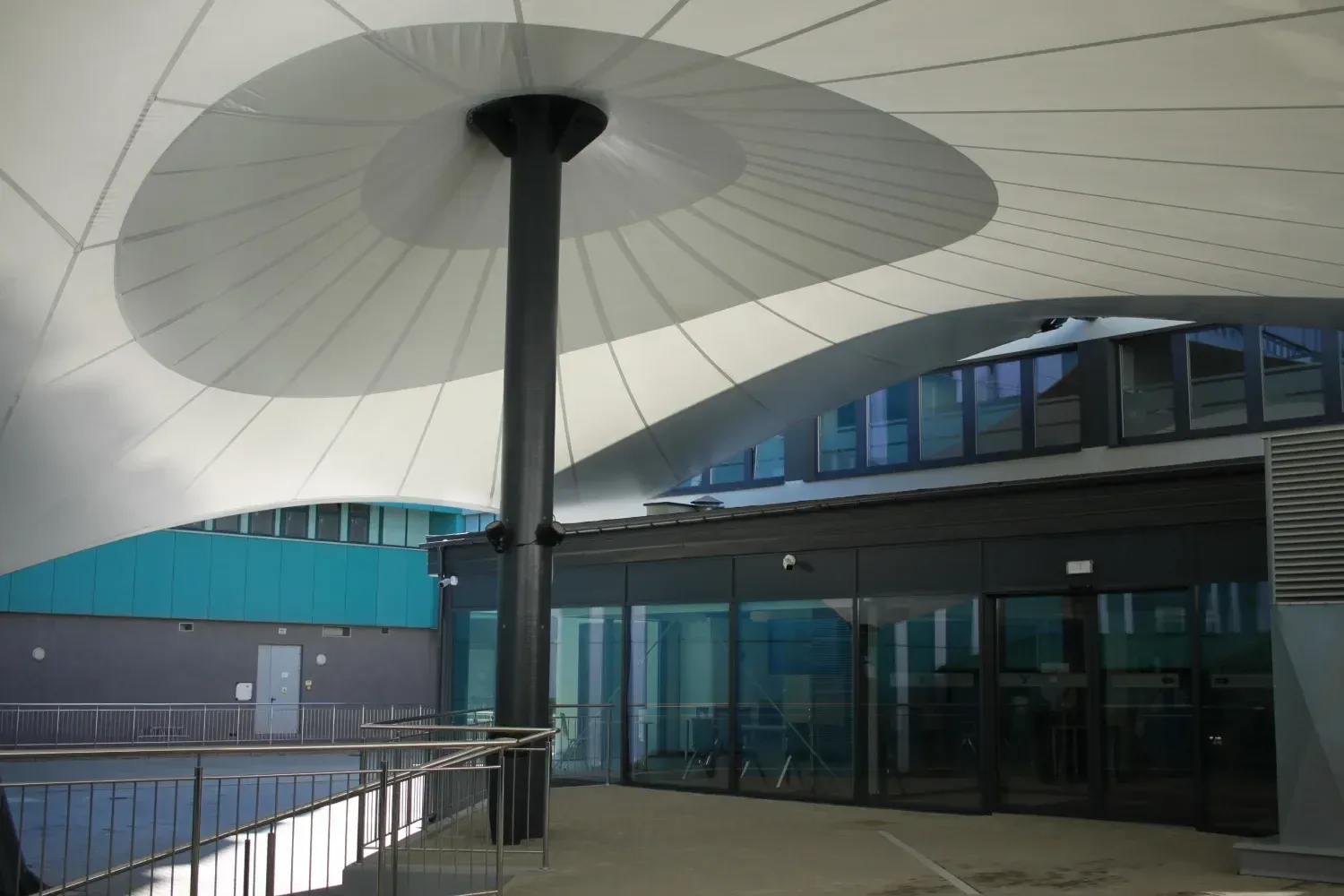
Tensile membrane structures have become one of the most distinctive elements of modern architecture. Their strength is in the combination of structural performance and visual identity — a well-designed membrane envelope is both a building element and a piece of sculpture. Behind that finished result is a manufacturing process that brings together engineering software, technical textiles, precision cutting and skilled installation. This is how a tensile membrane roof actually gets built.
Why tensile membrane roofs work
Tensile membrane roofs sit in a category of their own for several reasons. The fabric handles the load in tension only, which means very little material covers very large spans. The forms are doubly curved (anticlastic), which is what gives them visual identity and structural stability. And the technical fabrics behind the discipline — PVC-coated polyester, PTFE-coated fibreglass, ETFE foil — offer a combination of weather resistance, light transmittance and durability that no rigid material matches at the same weight.
For owners, that translates into:
- Low dead load on the supporting structure
- Long clear spans without intermediate columns
- Translucent, daylit interiors
- Service life of 25–30 years for premium fabrics
- Iconic visual identity for the building
How a tensile membrane project is manufactured
Step 1 — Form finding and engineering
Every membrane project starts in form-finding software (SOFiSTiK, TechNet Easy, EASY by technet, or similar). The engineering team defines the boundary conditions, applies the prestress, and lets the software find the shape that the membrane wants to take under load. This is not a sketch in CAD — it is a structural simulation that produces the actual geometry the fabric will hold once tensioned on site.
The output is twofold:
- The 3D shape of the envelope under prestress
- The flat cutting pattern that produces that shape, with compensation for fabric shrinkage
Wind tunnel analysis (computational or physical) confirms the design behaviour under wind and snow loads.
Step 2 — Material selection
Choosing the right fabric is mostly a question of project requirements. The default for most architectural projects is PVC-coated polyester with PVDF lacquer — strong, weather-tight, fabricable, and cost-effective. For larger spans, longer service life or more demanding environments, PTFE-coated fibreglass is the next step up. For projects where light transmission and weight are critical, ETFE foil is the right answer.
Each material has its own behaviour under prestress, its own welding parameters, and its own service-life profile. The selection has to be made early because it affects everything downstream — pattern compensation, welding setup, fixings, even the supporting structure design.
Step 3 — CNC cutting
Once the cutting pattern is finalised, the panels are cut on a CNC plotter from rolls of the chosen fabric. Modern nesting algorithms pack the panels onto the roll with 90%+ yield. Each panel is labelled with its position in the welding sequence and stacked in order for the welding line.
This is where the digital design becomes a physical object for the first time. From this point forward, every step is about preserving the geometry the form-finding model produced.
Step 4 — High-frequency welding
The cut panels are joined into the final envelope using high-frequency welding. HF welding fuses the PVC layer of two adjacent panels into a continuous bond as strong as the parent fabric. Seams are tested to confirm strength, and the assembled envelope is folded for transport to site.
For acoustically demanding spaces like sports halls and concert venues, additional acoustic absorber layers can be incorporated into the envelope at this stage.
Step 5 — On-site installation
The supporting structure — typically steel masts, cable nets or arch frames — is erected first. The membrane envelope is then unfolded, lifted into position, and tensioned to the design prestress. This is the moment of truth: a well-engineered envelope arrives flat and snaps into its 3D shape under tension exactly as the form-finding model predicted.
The installation team verifies the prestress with strain gauges or load cells, completes the edge fixings, and hands over the building with a documented as-installed state.
Where these structures end up
Sports and recreation
Tensile membrane roofs are a natural fit for sports facilities. The Nieciecza football stadium is one example — a long-span cantilever roof that gives spectators clear sightlines and weather protection without the dead load of a conventional structure. The same logic applies to indoor sports halls, swimming pools and athletic tracks.
Public and cultural spaces
Amphitheatres, market squares, restaurant terraces and outdoor event venues are all common applications. The Kasprowicz Park summer theatre in Szczecin shows what a well-designed amphitheatre canopy can do — it changes the experience of the venue completely while staying visually quiet against the surrounding park.
Private and commercial
Terrace covers, garden room roofs and commercial canopies sit at the smaller end of the scale. The ETFE cushion roof above a restaurant terrace in Kraków is a good example of how membrane technology scales down from stadium roofs to building-scale interventions without losing quality.
In summary
Manufacturing a tensile membrane roof is a process that spans engineering software, technical textiles, precision cutting, HF welding and skilled installation. Done well, it produces buildings that combine structural performance, daylit interiors and visual identity in a way that no other roofing system can match.
If you are planning a project where a tensile membrane roof could be the right answer, get in touch with Abastran — we will help you specify the right material, the right manufacturing approach and the right installation team.