
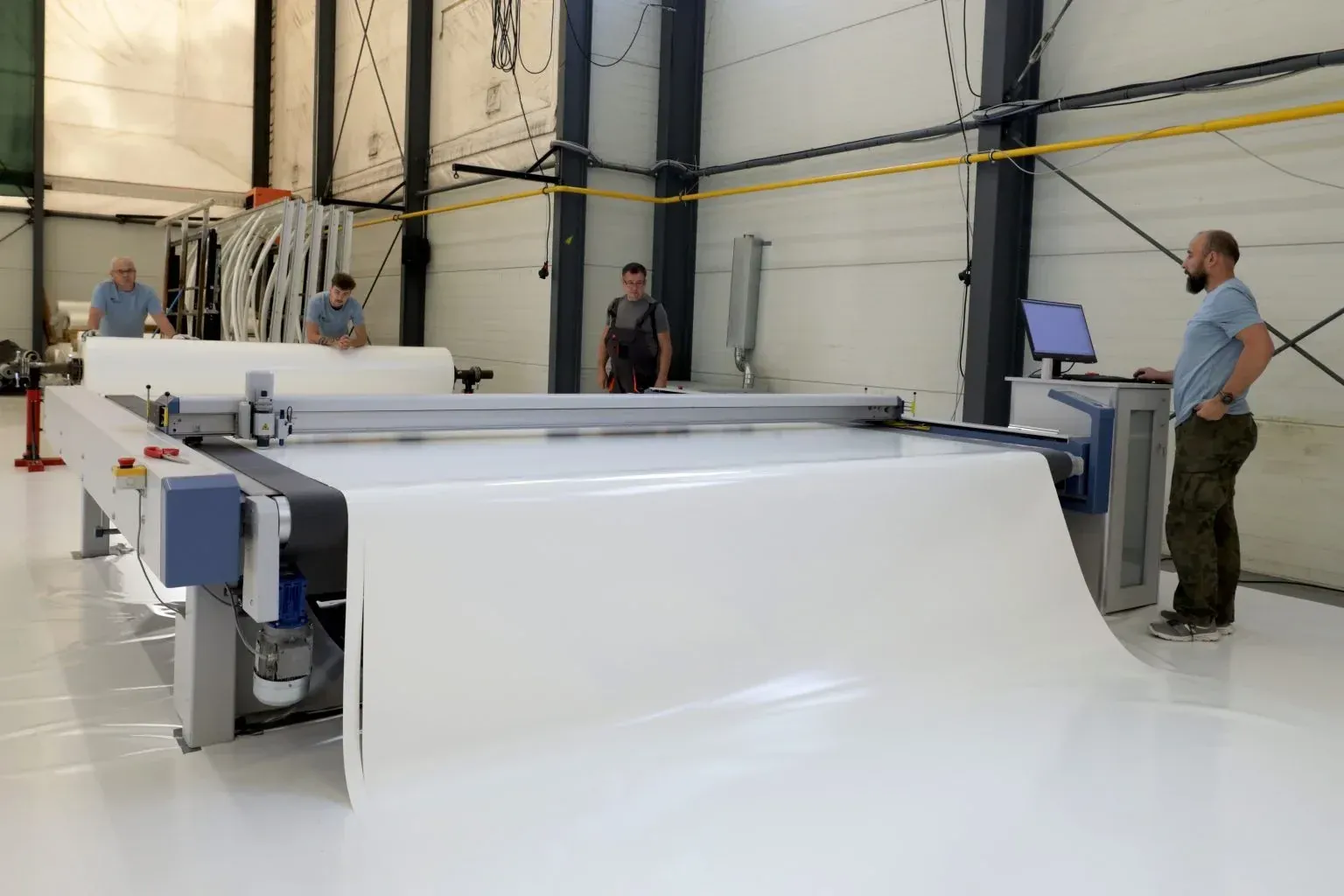
CNC plotter cutting has quietly become the foundation of every serious membrane fabrication workflow. The technology is mature, the economics are well understood, and the alternatives — hand cutting, die cutting, manual templates — all fall short when you scale up to architectural-grade work. Here is the technical case for why CNC plotters are now the default in PVC and PTFE membrane fabrication.
What a CNC plotter actually does
A CNC plotter is a flatbed cutting table driven by a computer. The cutting head moves on precision linear rails, controlled to better than 0.1 mm by the CNC controller. The pattern comes from a CAD/CAM file generated upstream by the design team — typically straight from the form-finding software that defines the membrane geometry.
For architectural membranes, the cutting head is usually a rotary blade or oscillating knife sized for the specific fabric. Sheet material is fed from a large roll and pinned or vacuum-clamped onto the bed during cutting. After each panel is cut, it is labelled and stacked in the welding sequence.
Six things CNC cutting gives you that nothing else can
1. Sub-millimetre precision
A CNC plotter holds positional accuracy of 0.05–0.1 mm across a working bed several metres wide. That is far beyond what any manual operation can match. For architectural membranes, where the cutting pattern has been generated from a 3D form-finding model with built-in compensation factors, that level of precision is the only way to make the panels actually fit the design when prestressed on site.
2. Material savings through nesting
Modern CAD/CAM software runs nesting algorithms that pack the panels onto the fabric roll as tightly as possible. Yields routinely hit 90% or higher, where manual cutting averages around 70–75%. For architectural fabrics that cost €15–€60 per square metre, the savings dwarf the operational cost of running the plotter.
3. Repeatability across runs
If a project calls for identical or mirrored panels — stadium roof modules, repeated canopies, ETFE cushions — every panel coming off the plotter is identical to the first. There is no operator drift, no slow degradation in accuracy, no surprise variance between batch one and batch ten.
4. Speed
Once the digital pattern is finalised, the plotter runs at 0.5–2 m/s depending on the fabric. A complex architectural panel that would take hours to mark and cut by hand drops to minutes on a CNC bed. Lead times shrink, and design iterations become cheap to incorporate.
5. Flexibility across materials
A single plotter handles PVC-coated polyester, PTFE-coated fibreglass, ETFE foil, silicone-coated technical fabrics, and a range of supporting materials (release films, primer tapes). The same machine that cuts a stadium roof module today cuts an ETFE cushion for an atrium tomorrow.
6. Automation and lower labour cost
Once the file is loaded and the fabric is on the bed, the operator’s role is to monitor the run and load the next batch. Productivity per operator is several times higher than with manual cutting, and the work is less physically demanding — both of which matter when you are running production at scale.
Where the upstream pattern comes from
The CNC plotter is only as good as the pattern it cuts. In a professional workflow, the pattern is generated upstream from a 3D form-finding model that defines the prestressed shape of the membrane envelope. Compensation factors are applied to account for fabric shrinkage when the prestress is applied. The result is a flat cutting pattern that — when welded into a single envelope and tensioned on site — becomes the exact 3D shape the architect designed.
This is the part that ties everything together. Without the CNC plotter, the form-finding model is just a simulation. With it, the simulation becomes a building.
Quality, repeatability and safety
Three less-obvious advantages worth calling out:
- Consistent quality — every panel meets the same tolerance, project after project. Quality control becomes a sampling exercise instead of a per-panel inspection.
- Repeatable batches — for fabricators with repeat clients (sports facility builders, biogas plant integrators, military tent suppliers), the ability to re-run the same job with identical results is a major commercial advantage.
- Operator safety — automated cutting eliminates the rotary blade and knife handling that cause most injuries on a manual line.
In summary
A CNC plotter is not a luxury for an architectural membrane workshop — it is the baseline. Without it, you cannot deliver the precision, the yield, the repeatability or the throughput that the modern market demands. The investment pays back through material savings alone within a year or two of typical workshop volumes.
If you have a project that needs precision membrane cutting — one prototype, one job lot, or production runs of identical panels — contact Abastran and we will discuss the right approach for your specification.