
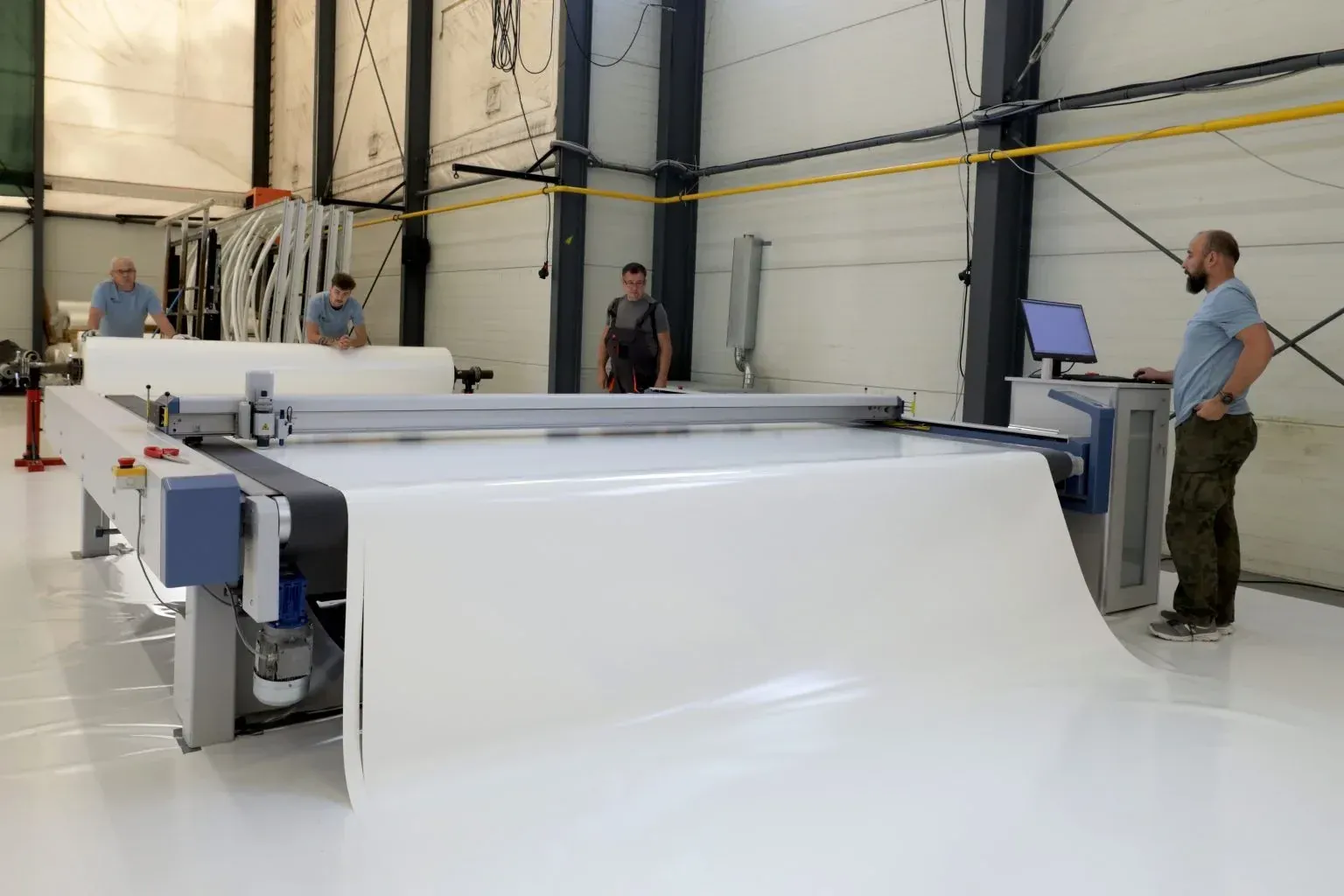
Precision CNC plotter cutting is the unsung backbone of every well-made membrane project. It is the step where a digital cutting pattern becomes a physical fabric panel, and the quality of that step determines whether the finished envelope fits perfectly or has to be reworked on site. Here is what professional CNC membrane cutting actually delivers and what to look for when you commission it.
What CNC plotter cutting is
A CNC plotter is a computer-controlled cutting table — essentially a large flatbed XY plotter with a precision cutting head instead of a pen. The pattern comes from a CAD/CAM file, the controller drives the head along the cut lines, and the result is a panel cut to the exact geometry of the digital pattern. For architectural membranes, this is the only viable way to handle the complex compound curves and free-form geometry that define the discipline.
Modern plotters handle everything from PVC-coated polyester for tensile structures, through PTFE-coated fibreglass and ETFE foil, to silicone-coated technical fabrics. Cutting speeds and tooling vary by material, but the workflow is the same: file in, cut panels out, ready for welding.
What precision actually buys you
Geometry that matches the design
Every architectural membrane project starts with a form-finding model — a 3D simulation that defines the shape of the envelope under prestress. From that model, the cutting pattern is generated, taking into account fabric compensation (the shrinkage that happens when prestress is applied). CNC plotter cutting reproduces those panels exactly. There is no drift between what the engineer designed and what reaches the welding bench.
Lower material waste
Nesting algorithms pack the panels tightly onto the fabric roll, and the plotter cuts each one exactly once. For an industry where the fabric itself can cost €15–€60 per square metre, that matters. Optimised nesting routinely brings yield up to 90% or higher, where manual cutting struggles to hit 75%.
Repeatability
For projects that involve identical or mirrored elements — stadium roof modules, repeated canopies, multiple cushions — CNC cutting guarantees that every piece is identical. There is no operator drift between the first panel and the hundredth.
Speed
Once the digital pattern is ready, cutting takes a fraction of the time a manual operation would need. Lead times shrink, and design changes can be incorporated without rebuilding paper templates from scratch.
How a professional service runs
The workflow at Abastran’s PVC confection workshop is straightforward:
- Brief and quote. We discuss the project, confirm the material specification, and prepare a quote based on your data and our nesting plan.
- Pattern preparation. Our specialists prepare or import the cutting pattern in CAD/CAM software, applying any compensation factors and adding cutting marks for the welding stage.
- Cutting. The plotter runs the job. Each panel is cut, marked and stacked in the welding sequence.
- Handover. Cut panels go to our welding line, or — if you are running your own assembly — they ship to you ready for the next step.
What you should look for in a service provider
Not every CNC cutting service is built for architectural membranes. The things that matter:
- Material range — can they handle PVC, PTFE, ETFE and technical fabrics, not just plain canvas?
- Cutting bed size — wide-format roll material needs a long bed
- Pattern handling — can they read your CAD/CAM output, or do you have to convert formats?
- Quality control — random checks during cutting catch alignment drift before it becomes a problem
- Welding integration — if cutting and welding happen under the same roof, the cut panels reach the welder in the right order with no handling losses
In summary
CNC plotter cutting is not optional for serious membrane projects — it is the foundation of everything that comes after. Done well, it gives you geometry that fits the design, minimal material waste, and panels that are ready for the welding line on day one.
If you are planning a project that needs precision membrane cutting — whether it is one prototype or a thousand identical modules — contact Abastran and we will walk you through the right approach.