
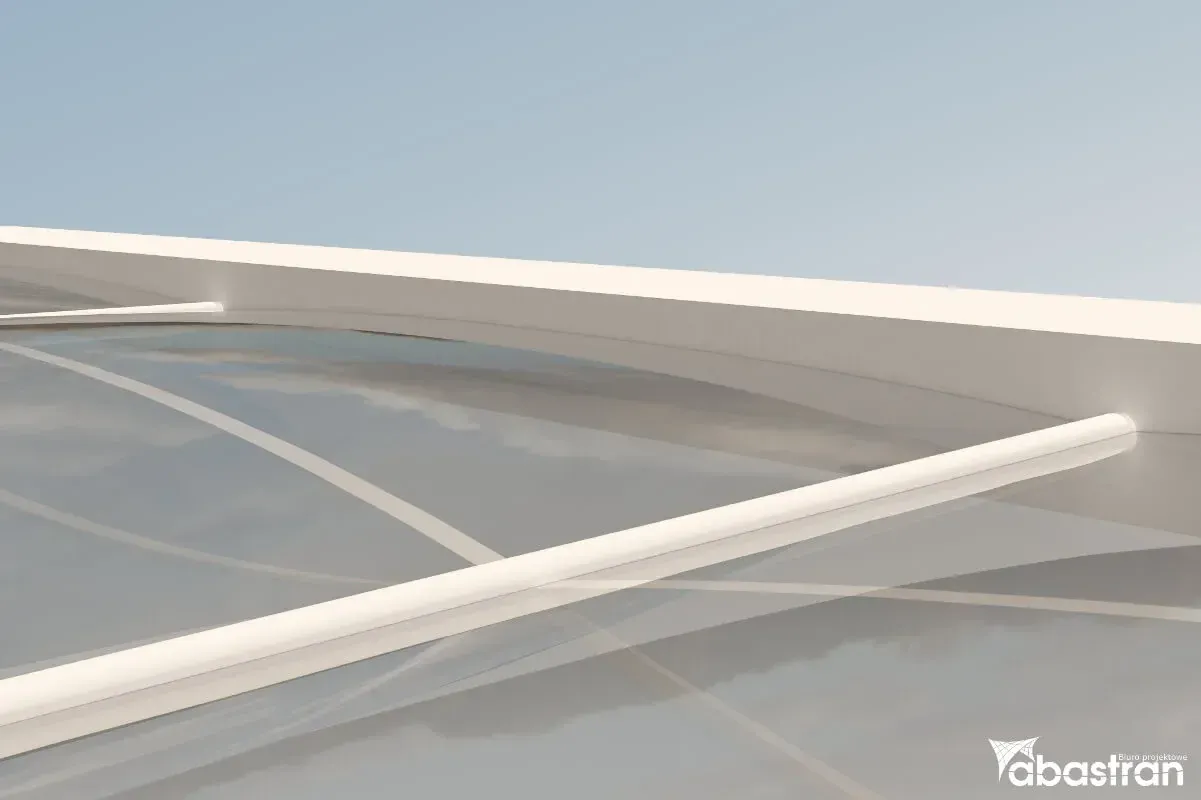
Planning a spectacular ETFE roof or façade? Excellent choice — ETFE delivers architectural possibilities that no other material can match. Before the vision becomes reality though, you need to navigate a maze of documentation, standards and certificates. One incorrect document, one certificate that covers a different system than the one in your project, and the safety and legality of the entire investment can be compromised.
This article is your practical guide to the certification world for ETFE construction. Step by step, in language that works for engineers and architects, we walk through what to check, how to read the documents, and the common mistakes to avoid.
Why ETFE in the first place
ETFE is an advanced fluoropolymer film. Practically, it lets you forget the limitations of heavy glass. ETFE foil is ultra-light — roughly 1% of the weight of an equivalent glass panel — which lets architects design enclosures with huge spans on minimal supporting structure.
The properties solve real engineering problems:
- Light transmission — up to 95%, giving brilliantly daylit interiors and lower energy bills
- Durability — high UV resistance means the foil does not yellow or become brittle. Service life is 30+ years
- Self-cleaning — the smooth low-energy surface releases dirt under rainfall, eliminating most maintenance
- Design freedom — any organic shape, from pneumatic cushions to tensioned single-layer canopies
These properties make ETFE ideal for stadium roofs, shopping centre atria, zoo enclosures (the famous Orientarium in Łódź is one example) and modern office façades. From Abastran’s experience, the key to success is treating the construction as an integrated system where the foil, the profiles and the fixings form an inseparable whole.
The standards you must know
The safety and quality of an ETFE construction rest on a handful of fundamental standards. This is not optional reading — it is your mandatory toolkit. You need to know what to demand from the contractor.
The foundation is the EN 1090 series. It governs the execution of steel and aluminium structures — that is, the framework that the ETFE envelope sits on. Without compliance with EN 1090, the supporting structure cannot legally be placed on the EU market.
- EN 1090-1 — sets out the conformity assessment requirements (the procedure that leads to the CE mark)
- EN 1090-2 — defines the technical requirements for steel structure execution
- EN 1090-3 — covers the technical requirements for aluminium structures
Fire safety is the next pillar. EN 13501-2 classifies construction products by fire resistance. For the foil itself, the more important classification is reaction to fire (more on this below). The supporting management system standards — ISO 9001 for quality management and ISO 3834 for welding quality — demonstrate the organisational and technical maturity of the contractor.
How ETFE certification actually works
The CE mark on a product is your guarantee that it has passed the full conformity assessment procedure. The producer of the system must implement and maintain a Factory Production Control (FPC) programme — an internal monitoring system that ensures every batch of product has the same declared properties.
Certification, performed by a notified body (such as a national construction technology institute), includes an FPC audit and initial type testing in a laboratory. Only after passing both stages can the producer issue the certificate and legally CE-mark the product.
Here is the most important point to remember: the CE certificate is issued for a specific tested system, not for ETFE foil as a raw material. That means the document covers a precisely defined assembly: foil of a specific thickness, profiles of a specific shape, and a specific fixing method. Changing even one element — for example using bolts from a different supplier — formally invalidates the certificate for the modified solution. At Abastran we are uncompromising on this: alignment of the designed system with the certified one is an absolute priority.
Fire resistance — decoding REI and B-s1, d0
Fire terminology can be confusing, so let’s unpack it. The REI classification applies to fire resistance of complete building elements:
- R — Load-bearing capacity (the element does not collapse under load)
- E — Integrity (the element does not let flames or hot gases through)
- I — Insulation (the element does not heat up excessively on the unexposed side)
A single layer of ETFE foil, as a meltable material, does not have an REI classification. For ETFE, the key classification is the reaction to fire rating. The best and most commonly required is B-s1, d0:
- B — material with very limited contribution to fire spread
- s1 — very low smoke emission
- d0 — no flaming droplets
In practice, in case of fire ETFE foil melts and shrinks, creating natural openings for smoke and heat to escape. It does not sustain combustion and does not create burning fragments that could spread the fire. This is a significant advantage compared to PVC.
How to read certificates without making expensive mistakes
You receive a stack of documents from the contractor. Now what? Here is your checklist:
- Check the data — does the producer name, system name and factory address on the certificate match the offer?
- Verify the scope — does the certificate describe exactly the system (profiles, foil thickness, fixings) that you have in your project? Compare the technical drawings on the certificate with those in the project documentation
- Check the validity date — make sure the certificate is current
- Check the notified body — does the institution that issued the document have the authority to certify products of this type? You can verify this in the EU NANDO database
The most common mistake? Accepting a generic foil datasheet instead of a CE certificate for the complete construction system. As the owner or supervising designer, you carry the final responsibility. When in doubt, do not hesitate to ask the contractor or have the documentation reviewed by an independent expert.
ETFE vs PVC vs PTFE — which membrane for which project
Material selection is always a compromise between cost, aesthetics and technical performance. Here is how ETFE compares to its alternatives.
ETFE — ideal when transparency, weight, durability and design freedom are the priority. Premium pricing, but the long service life and low maintenance costs often offset the higher initial investment.
PVC — the more economical option. Polyester base fabric coated with PVC is flexible and available in many colours. The trade-offs: shorter service life (15–20 years), greater susceptibility to soiling, and (most importantly) worse fire performance with the possibility of toxic smoke release.
PTFE — polytetrafluoroethylene-coated fibreglass is the master of fire resistance (class A2-s1, d0) and durability. It is opaque (transmits only diffused light), heavier and significantly more expensive. Choose it where fire codes are extremely strict and transparency is not a priority.
Bottom line
Understanding the standards and being able to read certificates is your superpower in the construction process. It is not bureaucratic overhead — it is a tool for conscious management of quality and safety. With this knowledge you can confidently realise even the most ambitious architectural projects.
If at any stage you need expert support from a team that works with these technologies every day, the Abastran team is at your disposal.