
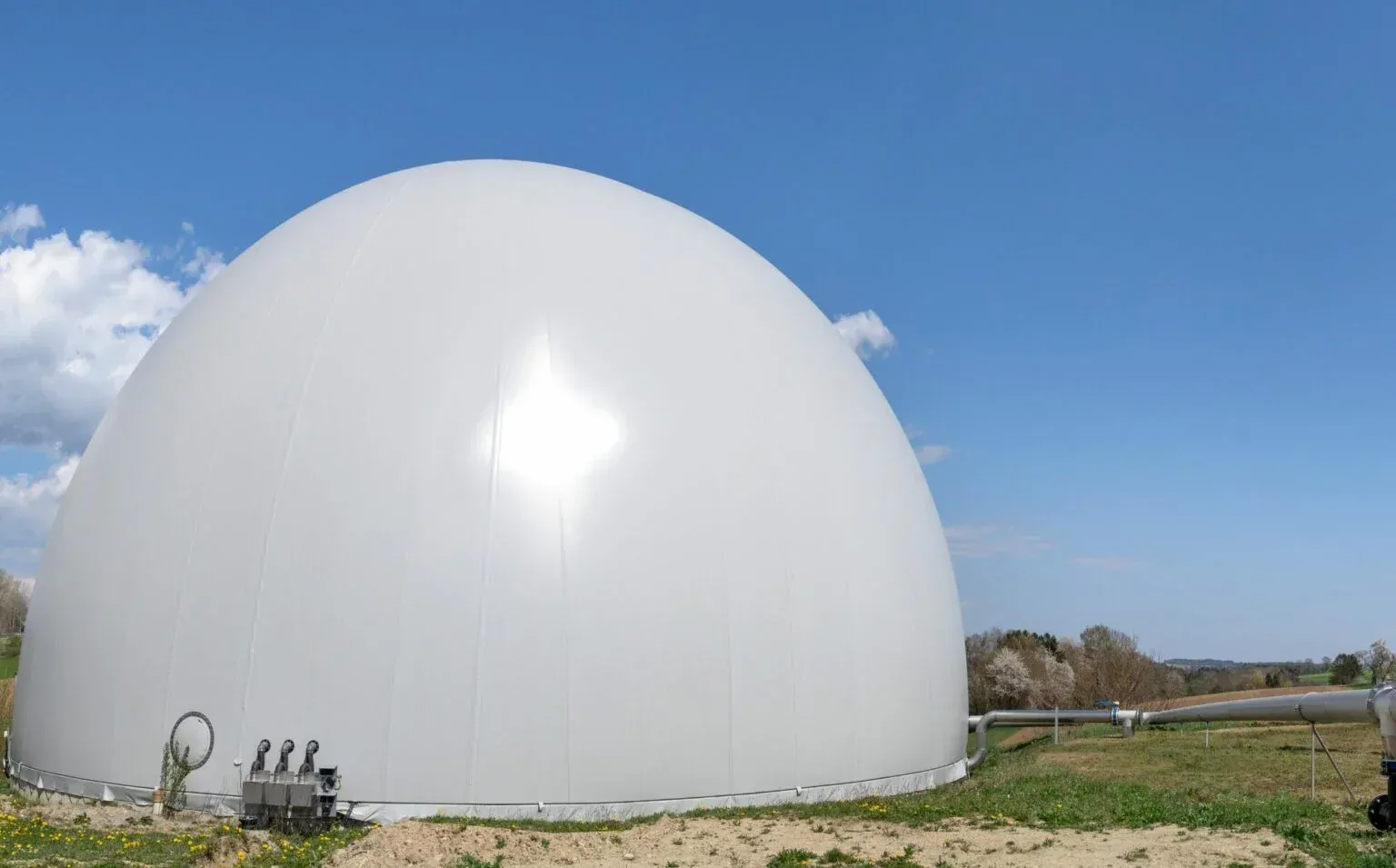
In a world of rising energy demand and climate pressure, biogas has emerged as one of the most reliable renewable sources of energy. Unlike solar or wind, biogas production is not weather-dependent — a digester can produce power and heat 24 hours a day, regardless of conditions. The membrane biogas domes that cover and store the gas at the top of every digester are a critical part of how that works. Abastran’s experience with high-performance architectural membranes carries over directly into this sector, where airtightness and durability are non-negotiable.
How biogas is produced
Biogas is the product of anaerobic digestion — the breakdown of organic matter by micro-organisms in the absence of oxygen. Inside a digester tank, optimum temperature, pH and feedstock conditions are maintained so that the bacteria release a gas mixture made up mostly of methane (50–70%) and carbon dioxide (30–50%), with traces of hydrogen sulphide, ammonia and water vapour.
The choice of feedstock determines how efficient the plant is. Common substrates include:
- Food and agricultural waste (fruit, vegetable, dairy by-products)
- Maize silage and other energy crops
- Slurry and manure
- Sewage sludge
- Food industry by-products
This flexibility is one of biogas’s biggest advantages. Local organic waste streams that would otherwise end up in landfill — releasing methane into the atmosphere — get diverted into a controlled process that produces clean energy. Methane, after all, is 28 times more potent than carbon dioxide as a greenhouse gas, so capturing it has a double benefit.
Inside a membrane biogas dome
A modern biogas dome is a double-membrane gas holder sitting on top of the digester tank. It serves two purposes simultaneously: it covers the tank, and it stores the gas the tank produces. The construction has to handle harsh conditions — UV radiation, temperature swings, and chemical attack from the gas itself.
A typical assembly includes:
- An outer weatherproof membrane resistant to UV, wind and snow
- An inner gas-tight membrane that contains the biogas
- A pressure-control system that keeps the air space between the two membranes at a constant pressure
- A flexible gas storage volume that rises and falls as gas is produced and drawn off
- Sensors and safety systems for pressure, gas composition and temperature
The double-membrane design has a clever side benefit: the outer membrane stays in a fixed shape regardless of how much gas is in the storage volume, because the air pressure between the layers compensates. Operators get a stable, professional-looking installation, and the gas is contained safely throughout the operating cycle.
The same fabric technology that goes into tent hall covers and tensile membrane structures shows up in biogas applications — high-tenacity coated polyester or specialised fluoropolymer fabric, joined with high-frequency welding to create gas-tight, mechanically strong assemblies.
The biogas opportunity in Poland and beyond
Poland alone has a theoretical biogas production potential of 13–15 billion m³ a year — roughly half the country’s annual natural gas demand. As of 2024, only around 380 biogas installations are operational, including 148 agricultural plants. The gap between potential and reality is huge, and the European policy push toward energy independence is closing it fast.
A point that often gets missed: biogas is the perfect complement to solar and wind. Where solar and wind are intermittent, biogas runs continuously. Combined with cable pooling — sharing grid connection points between different renewable sources — biogas plants can stabilise a renewable-heavy grid in ways that no battery system can yet match at scale.
In summary
Membrane biogas domes are the part of a biogas plant where storage, weather protection and safety all come together. Their construction is more demanding than a typical architectural membrane — but the underlying skills (CNC patterning, high-frequency welding, on-site assembly, design for long-term outdoor exposure) are exactly the same as those that go into high-end tensile architecture.
If you are working on a biogas project and want to discuss the membrane envelope or storage dome, get in touch with Abastran — we will help you specify a solution that fits the demands of your installation.