
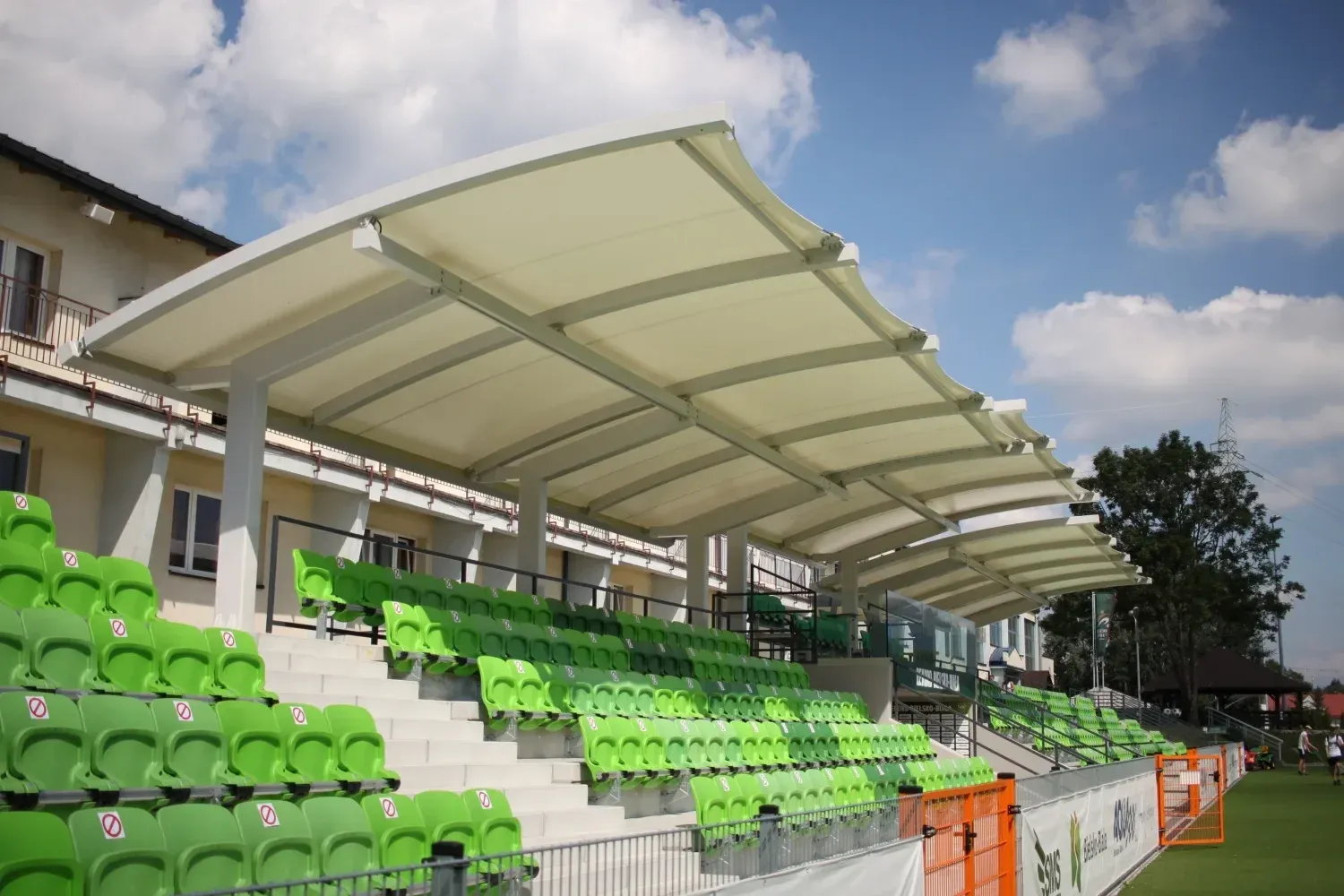
Tensile membrane roofs have become a default architectural answer for sports facilities. They are light, flexible and exceptionally durable — and modern materials like ETFE foil and PVC-coated polyester are engineered to handle whatever the weather throws at them. But is a membrane envelope really the right answer for a sports facility brief? This article walks through the case and shows why it has become such a strong choice.
The case for membrane roofs in sports
Lightweight construction
The defining advantage is weight. A typical PVC architectural membrane weighs between 800 and 1500 g/m² — a fraction of any rigid roof at comparable performance. That cascades through the entire structure: lighter supporting steel, lighter foundations, lower embodied carbon. For stadium-scale projects where the roof spans 50–100 metres without intermediate supports, the weight saving is what makes the structural concept work at all.
Weather protection that lasts
Membrane roofs handle rain, snow, intense sun and UV radiation as a matter of course. Premium PTFE-coated fibreglass and PVC-coated polyester both run 25+ years of full outdoor exposure without significant degradation. Spectators stay dry and shaded, athletes get reliable conditions for training and competition, and the operator is not signing up for major roof replacements every fifteen years.
Long clear spans, open volumes
Membrane envelopes naturally produce long clear spans because they work in pure tension. That gives the architect the freedom to roof a sports hall or stadium without intermediate columns blocking sightlines. For sports facilities — where every spectator needs an unobstructed view of the action — this is decisive.
Long service life, low maintenance
Modern membrane roofs need very little routine attention. Self-cleaning topcoats wash dirt away in normal rain, the fabric does not corrode or rot, and there is no painting cycle. An annual visual inspection plus an occasional wash is the entire maintenance plan for most installations. Compared to a steel-and-glass roof that needs decade-scale repainting and reseating cycles, the operational savings add up quickly.
Where membrane roofs work in sport
Football pitches and ball courts
A football pitch cover is one of the most common applications. The combination of long span, weather protection and reasonable cost makes membranes the natural choice for everything from amateur club facilities up to professional stadium grandstands. The translucent fabric lets enough natural light through that artificial lighting is only needed in marginal conditions, which directly lowers operating costs.
Tennis courts
Tennis courts particularly benefit from controllable light transmission. ETFE and PVC membrane covers can be specified for a target translucency, optimising daylight without glare. The result is a court that plays well in any weather and at any time of day. Pneumatic ETFE cushion covers take this even further with multi-layer envelopes that combine daylight with thermal insulation.
Swimming pools
ETFE foil cushions are the standard for premium swimming pool covers because of their extreme light transmission and self-cleaning surface. The pool stays bright, the air quality stays good, and the structure handles condensation and chlorine exposure without degradation. For commercial pools and Olympic-class facilities, ETFE has effectively become the default.
Grandstand canopies
Spectator protection is the priority in any stadium project, and tensile membrane grandstand canopies have become the standard answer. They are light enough to cantilever 20–30 metres without intermediate supports, blocking sun and rain while preserving sightlines. Modern stadium projects routinely specify membrane grandstand canopies as the default, with rigid alternatives reserved for special cases.
Pneumatic structures — a related technology
Pneumatic (air-supported) structures are a closely related technology that uses internal air pressure to maintain the envelope shape. For temporary or seasonal sports facilities — winter tennis courts, swimming pool covers, training halls — they offer a different combination of advantages: extremely fast installation, no internal columns, good thermal insulation in multi-layer configurations, and the ability to be removed and stored when not needed. They are the natural answer when seasonal usability and rapid deployment matter more than the architectural permanence of a fixed membrane envelope.
What a real project looks like
Building a tensile membrane roof for a sports facility runs through four main steps:
- Engineering — architects and structural engineers design the envelope around the specific brief: span, sightlines, wind and snow loads, lighting requirements, cost target.
- Material selection — PVC, PTFE or ETFE, depending on span, light transmission requirements, target service life and budget.
- Fabrication and installation — panels are CNC-cut and HF-welded in the workshop, the supporting structure is fabricated, and everything is installed on site over a much shorter window than rigid construction would need.
- Maintenance — modern fabrics need minimal upkeep, but a planned inspection and cleaning programme will extend the service life significantly.
In summary
Tensile membrane roofs combine lightness, durability, long clear spans and visual impact in a way that maps almost perfectly onto sports facility briefs. They are the default answer for stadium grandstand canopies, the premium answer for pool and tennis court covers, and a strong contender for almost any sports project where span and daylight matter.
If you are planning a sports facility build or upgrade, Abastran offers complete tensile membrane solutions, from concept through installation to long-term service. Get in touch and we will help you scope the project and specify the right system.