
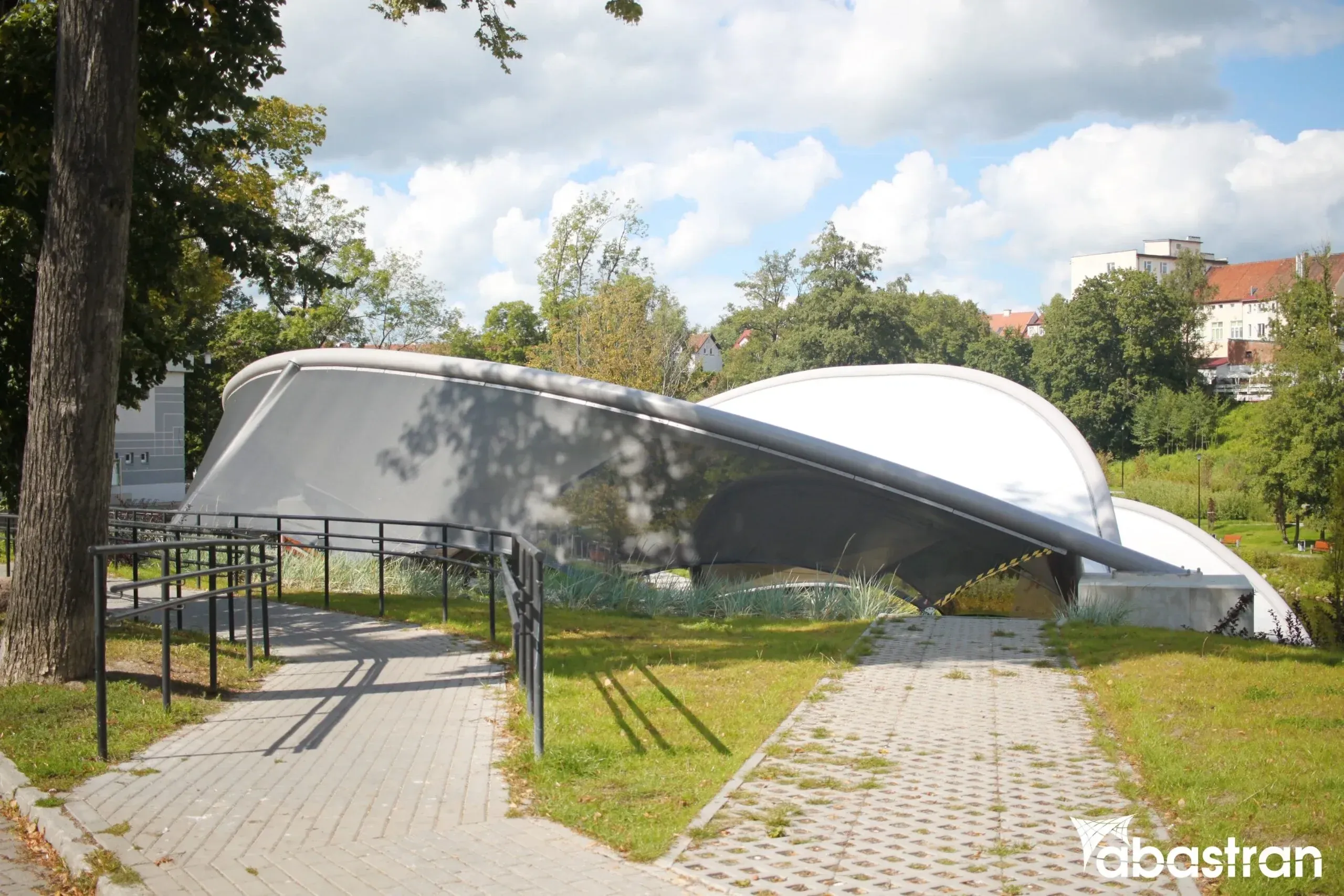
Iconic stadiums, modern shopping centres and dramatic amphitheatres often share one feature: a light, expressive tensile membrane roof. What started as architectural avant-garde has become a serious commercial choice. A membrane envelope — a high-performance technical fabric (typically PVC, PTFE or ETFE) tensioned over a steel supporting structure — is now a genuine alternative to traditional steel, concrete, sheet metal or tile roofs.
When a project owner is choosing a roof technology, four factors usually drive the decision: capital cost, construction time, finished aesthetic, and long-term durability and operating cost. Picking between a heavy, proven structure and a lightweight, innovative membrane envelope is rarely obvious. This article walks through the decision step by step and shows the specific situations where modern membrane roofs are essentially without competition.
How a tensile membrane roof actually works
A membrane roof works on a fundamentally different structural principle than a traditional one. Instead of carrying load by compressing and bending massive elements, it uses tensile forces. The structure has three main components: a high-performance technical fabric, a system of steel masts, arches or frames, and a precise network of cables and tension rods. The prestress applied to the fabric makes it stiff, stable and capable of carrying real loads — wind, snow, the lot — while keeping the entire envelope dramatically lighter than any rigid alternative.
The key technical difference is that the membrane works in pure tension. Traditional roofs based on beams, rafters and panels work mostly in compression and bending, which forces them to be heavy and material-intensive. Textile architecture — as the discipline is often called — creates flowing organic forms with very long spans that would be expensive or impossible to achieve in concrete and steel. The choice of fabric (flexible PVC, durable PTFE or transparent ETFE) determines the final properties: light transmission, service life, and maintenance demands.
Membrane vs traditional roof — a side-by-side
The decision often boils down to capital cost, time, and technical parameters.
Tensile membrane roofs typically have a lower initial cost (CAPEX) because they use less material, the supporting structure is lighter, and installation is significantly faster. They can run higher operating costs (OPEX), since premium fabrics need periodic inspection and specialist cleaning. Traditional roofs cost more to build but typically need less attention over their service life.
Durability and weight are the next axis. A well-designed PTFE-coated fibreglass membrane runs 30+ years in standard climate conditions. In zones with extreme snow or wind loads, heavy steel and concrete construction can offer more headroom and potentially exceed 50 years of service life. The unbeatable advantage of a membrane is the weight: dramatically lower load on foundations, the ability to roof structures with limited bearing capacity, and lighter supporting steel everywhere.
Form freedom and aesthetics is the field where membranes simply win. Tensile membranes allow almost any sculptural shape, creating buildings that are visually distinctive and instantly recognisable. Materials like ETFE and certain PTFE grades transmit natural daylight, which lowers lighting demand and improves the experience under the roof. Traditional roofs offer much less design flexibility — mostly flat planes and simple geometries.
Comparing the key parameters
| Feature | Tensile membrane roof | Traditional roof (steel, concrete, panel) |
|---|---|---|
| Initial cost | Typically lower | Typically higher |
| Installation time | Short (prefabricated) | Long (in-situ) |
| Roof weight | Very low (1–15 kg/m²) | Very high (50–500 kg/m²) |
| Service life | 20–35 years (material dependent) | 50+ years |
| Form and aesthetics | High design freedom, distinctive | Limited to simple geometry |
Six scenarios where a membrane is the right answer
Modern tensile membrane structures are not a universal solution, but for certain briefs they leave traditional approaches behind. They are the right answer when one of the following situations applies — when lightness, speed of construction, and visual impact become decisive factors and the membrane offers the optimal balance between cost and benefit.
1. Long-span structures
Stadiums, sports halls, airports and exhibition centres need to cover huge floor areas without intermediate columns. A lightweight membrane is both economically and structurally efficient at this scale. Stadium grandstand canopies are a textbook example.
2. Projects with high visual ambition
When the roof needs to be the visual signature of the building — to attract attention and shape the brand — the sculptural plasticity of membranes lets architects create iconic forms. Shopping centres, outdoor stages and cultural venues all benefit from the unique character that membranes can provide.
3. Tight construction schedules
Off-site fabrication and fast on-site installation dramatically shorten the project timeline. For commercial projects where time-to-revenue is critical, that speed is often worth more than the marginal capital cost difference.
4. Buildings with limited structural capacity
Roofing an existing courtyard, modernising a historic building, or building on weak ground are all situations where the low weight of a membrane envelope eliminates the need for expensive foundation reinforcement.
5. Daylight requirements
Membranes — especially translucent ETFE foil — let natural daylight flood the space underneath. Atria, train station platforms, botanical gardens and similar spaces all benefit enormously from a daylit envelope.
6. Temporary or mobile structures
Light weight and ease of installation/demountability make membranes ideal for seasonal restaurant terraces, event spaces and exhibition pavilions that need to come and go.
When to stay with a traditional roof
Despite the advantages, membrane roofs are not always the right answer. There are situations where proven, heavy technologies offer more security and predictability over the long term. A traditional concrete, steel or sheet roof is justified when the priority is maximum resistance to extreme conditions, or minimal maintenance over many decades.
Traditional roofs are the safer choice in locations exposed to extreme climate loads — high snow zones (4 and 5 in Polish climate), or areas with very strong winds. The mass and stiffness of a heavy structure gives a larger safety margin in those conditions. If the project is sized for a very long service life (50+ years) with absolutely minimal maintenance, a traditional roof can be more cost-effective over the full lifecycle. The local availability of specialist service companies also matters — without them, periodic inspection and cleaning of a membrane becomes more expensive. Finally, acoustic requirements are a real factor: a single-layer membrane is a poor sound barrier, which can be problematic in production halls or concert venues. Multi-layer acoustic membrane systems exist but they add significant cost.
Decision factors — an investor’s checklist
The choice between membrane and traditional construction is a strategic decision that affects the whole project. To make it well, you need to analyse costs across the full lifecycle of the building, not just the construction phase. The key is understanding the difference between capital cost (the upfront construction spend) and operating cost (maintenance, repair and replacement over time).
Before committing, every owner should answer these fundamental questions:
- Budget — what is the relationship between the available capital budget and the planned operating costs?
- Climate conditions — what snow and wind zone is the site in? Are there extreme weather events?
- Schedule — how critical is project completion time? Is there pressure for early delivery?
- Service availability — are specialist installation and inspection teams available locally for membrane structures?
- Visual ambition — does the roof need to be a marketing feature? Is its unique shape a value driver?
- Function — is daylight required inside? What are the acoustic and thermal insulation requirements?
In summary
Membrane roofs are the right answer for a defined set of project briefs — long spans, visual ambition, fast schedules, weight-limited supports, daylight, and temporary or seasonal use. Traditional roofs are the right answer when the priority is extreme load resistance, minimal maintenance over very long lifecycles, or strict acoustic performance. The interesting decision space is everywhere in between, and that is where most modern projects sit.
If you are evaluating a membrane roof for a project, get in touch with Abastran — we will help you assess whether a membrane is the right answer and how to specify it properly.