
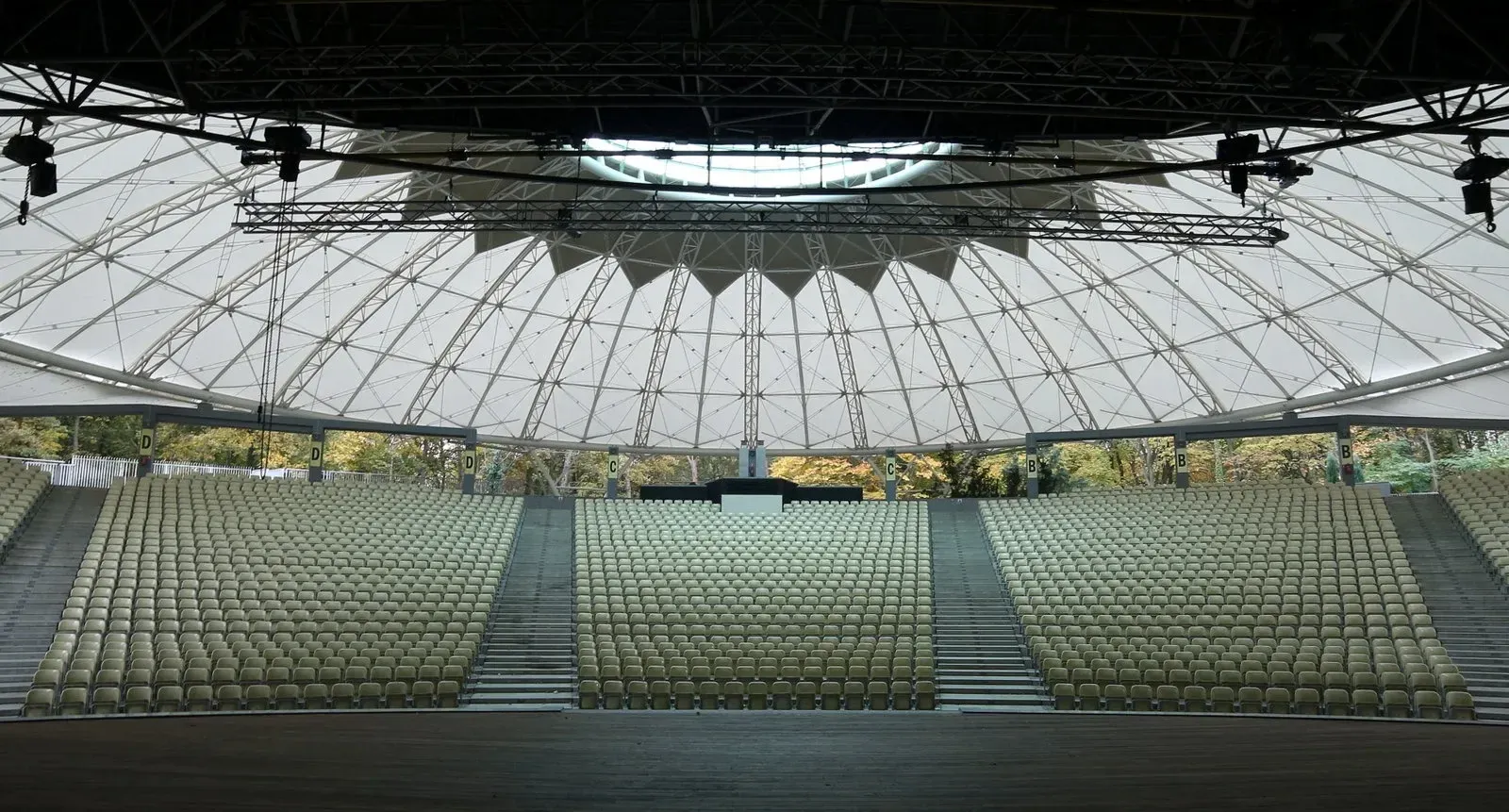
You are facing the challenge of designing a canopy for an amphitheater. This is not just a roof. It is a structure that has to combine aesthetics with strict safety requirements, acoustics with resistance to extreme weather, architectural vision with structural physics. How do you bring all these elements together into a coherent, functional, inspiring project? Is a lightweight tensile membrane structure the right answer, or perhaps a proven steel structure with polycarbonate cladding?
This guide walks you through the key decision points and technical phases. Instead of dry definitions, you get practical guidance based on engineering experience. We show you what to watch for, what mistakes to avoid, and what modern technology makes possible. Treat this as a consultation with engineers who turn ambitious concepts into real, safe structures every day.
Foundations of your project — where to start
Before you dive into material and structural selection, you need to precisely define the boundary conditions of your project. This is the absolute foundation that drives every subsequent technical decision.
Start with climate load analysis. You need to precisely define the snow and wind zone for the location according to current EN standards. This is not a formality — the safety of thousands of people depends on it. Does the structure need to handle 1.2 kN/m² of snow load, or extreme 2.0 kN/m²? What are the wind pressure and suction values for the proposed roof geometry? Only with this data can you start thinking about the form and materials of the structure. Equally important is analysing the local context — is the site in a heritage protection area? Such a situation often imposes a requirement for visual lightness and minimal intervention in the surroundings, which can push you toward slim cable structures or transparent cladding.
Choosing the roof material — membrane, polycarbonate, or ETFE?
The choice of roofing material is a decision that affects everything from appearance through operational properties to the supporting structure requirements. Each solution has unique technical parameters that must match your project assumptions.
Membrane canopies — lightness and sculptural form
Modern membrane canopies are the domain of lightweight spatial structure engineering. They allow long spans with minimum self-weight. They are the ideal solution when you want a spectacular, organic form.
- PVC membranes — economical and proven, offering significant design flexibility and 15–20 year service life
- PTFE membranes — Teflon-coated, with exceptional UV and dirt resistance. Self-cleaning surface significantly lowers maintenance costs. Service life of 30+ years
- ETFE foil — ultra-light, transparent, often used in two- or three-layer pneumatic cushions. Excellent daylight transmission, thermal performance, and almost unlimited shaping possibilities
In Abastran projects we often use form-finding — analysing membrane stresses with advanced software to find the optimal stable shape. This is critical for the safety and durability of tensile structures.
Polycarbonate panels — proven durability and daylight
A polycarbonate roof is valued for its excellent balance of technical parameters and versatility. If your priorities are durability, fire safety and optimal daylighting, this is a direction worth considering.
The key parameter is the fire classification. For public-use buildings, the absolute minimum is fire-classified panels (NRO — non-fire-spreading). Multi-wall polycarbonate also offers good thermal and acoustic insulation thanks to its cellular structure. Modern panels include UV protection layers that prevent yellowing and material degradation.
Supporting structure — steel, timber or cable system?
The roof cladding, whatever its type, needs a solid framework. The supporting structure carries all loads to the foundations and ensures stability. The system choice depends mainly on span, cladding weight and the desired architectural effect.
The most common and most versatile solution is a steel amphitheater structure. It allows almost any form, from massive prefabricated arches to slim space trusses. The key is optimising sections and connections to deliver the required load capacity at minimum mass. An alternative is glued laminated timber (GLULAM), which brings warmth and natural character but requires more rigorous maintenance.
Lightweight cable structures are increasingly popular, particularly for membrane canopies. At Abastran we specialise in designing such systems where membranes are tensioned over steel masts and tie-downs. This technology minimises the number of supports and creates the impression that the roof floats in the air. It is engineering at its purest, where every element works at maximum efficiency.
Acoustics under control — how the roof affects sound
An amphitheater canopy is a powerful acoustic modifier. It can become your ally — acting like a concert shell and amplifying sound — or your enemy, creating echo and reverberation problems. Roof shape and material are critical here.
Hard, smooth surfaces like glass or polycarbonate strongly reflect sound waves. Properly shaped, they can direct sound to the audience, improving audibility. Membranes, depending on their tension and surface mass, can both reflect and partially absorb sound. ETFE foil cushion systems offer different properties again. Consultation with an acoustic engineer at the concept stage is essential. Computer simulations let you optimise roof geometry and avoid acoustic problems in the finished building.
From concept to delivery — phases and challenges
Delivering a project as complex as an amphitheater canopy requires iron discipline and a well-thought schedule. From Abastran’s experience, the key to success is splitting the process into logical successive phases:
- Analysis and feasibility study — defining assumptions, analysing constraints, initial concepts
- Concept and building permit design — developing the chosen concept, structural calculations, obtaining permits
- Detailed design — the heart of the process. Detailed shop drawings for every element, connection details, material specifications
- Prefabrication — workshop production of structural elements, ensuring the highest quality and precision
- Assembly — transport logistics, site preparation, precise assembly using specialist equipment
Challenges can arise at every phase. Unexpected ground conditions requiring foundation modifications, transport problems for large elements, or the need to work in restricted time windows. That is why your engineering partner needs experience in risk management and the ability to react flexibly to changing conditions.
Durability and inspections — long-term safety
Designing and erecting the structure is only half the story. The real test is time. To make your canopy safe and functional for decades, you need to plan its maintenance and inspections from the start.
Each structure type needs a different maintenance plan. Membrane canopies require regular inspection of cable tension and the cover condition. Steel structures need inspection of corrosion protection and bolted connections. Timber requires checks on impregnation and biological corrosion. A good detailed design should include a maintenance and inspection manual that clearly specifies what, how, and how often to check.
Designing an amphitheater canopy is a fascinating journey through modern engineering. It is a chance to create a building that is not only safe and functional but becomes an architectural icon and the heart of a local community.
If you are facing such a challenge and want your vision delivered with the highest engineering care, consult your project with our team. At Abastran we combine creative passion with hard technical knowledge to deliver structures that exceed expectations.