
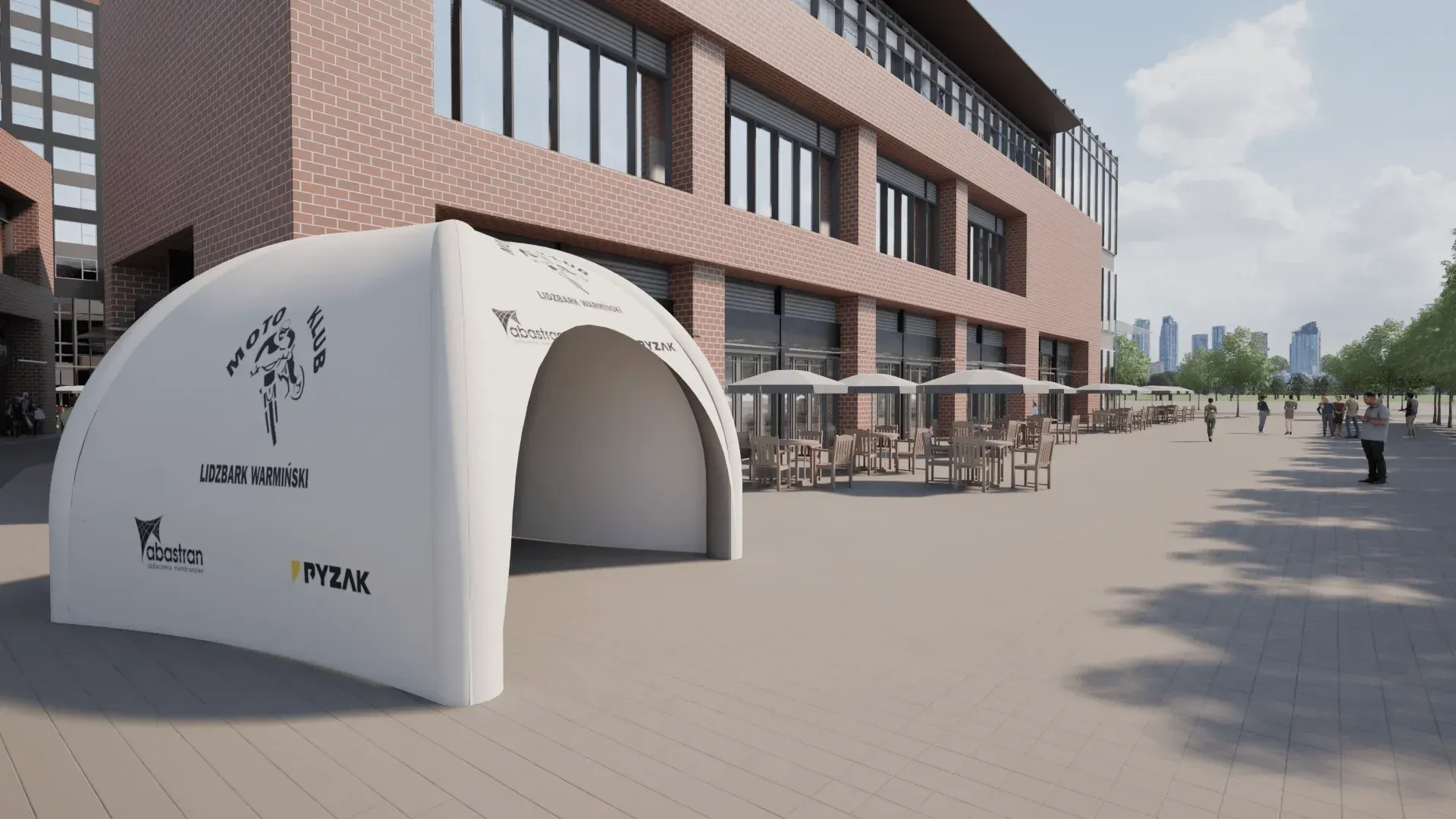
In the noise of competing stands at trade shows, festivals and outdoor activations, breaking through with your brand message is a real challenge. Companies compete to attract attention and often overlook the foundation that could be their most effective advertising medium. That foundation is the branded event tent — a solution that combines practical shelter with the power of a mobile billboard.
It is much more than a temporary canopy. It is a strategic event marketing tool that — through its mobility, large brand surface and ROI potential — can directly affect business results. This article walks through the selection, design and economics, proving that a well-planned tent is an investment that pays back at every event.
Why a branded tent is an investment, not a cost
Treating a branded tent as a pure operating expense is a fundamental mistake. In reality it is a long-term marketing asset whose value amortises over every event. Unlike fleeting digital campaigns or one-off press ads, a professional pop-up tent serves a company for many seasons, consistently building visibility.
Return on investment (ROI) is measurable not only through direct sales at the stand but also through brand awareness gains that translate into future purchase decisions. A single tent can be used at industry trade shows, family festivals, local sports events, and as a promotional point in front of company headquarters — every time working for the brand image.
When analysing economics, it is worth using metrics from other advertising channels — Cost-Per-Mille (CPM), the cost of reaching one thousand viewers. The cost of buying a tent, spread across dozens of events over several years, is often significantly lower than the equivalent spend on outdoor advertising.
The break-even point for buying a tent is typically reached after 4–5 events per year compared to regular rental costs. There are storage costs to factor in, but for companies actively working in the field, owning a permanent ready-to-use medium is an invaluable logistical and financial advantage.
How a tent boosts brand visibility on site
In a crowded trade show or festival ground where most stands blur into a uniform mass, a tall, colourful tent becomes a visual landmark. Its roof, rising above the crowd, is visible from a distance and acts as a magnet for potential customers’ attention.
It is the first thing that communicates your brand presence, before any visitor reads any brochure. A professionally made tent with strong graphics builds an immediate impression of solidity and attention to detail, which subconsciously transfers to the perception of the entire company and its offering. It is an investment in a first impression that you cannot make twice.
The power of the tent lies in its huge brand surface that can be fully developed. A standard 3×3 metre model offers nearly 35 m² of printable space covering the roof and walls. This allows XXL-format branding that is impossible to ignore. The key strategy is the 360-degree effect — placing the logo not just on the front valance but on every wall and the roof peak ensures the brand is visible from every direction. This comprehensive exposure maximises memorability and locks the brand into the audience’s awareness.
Picking the right model for your goals
The most popular and versatile solution on the market is the pop-up branded tent, based on a scissor frame. The main advantage is rapid assembly and disassembly — a trained crew can do it in literally 60 seconds, which is invaluable for dynamic activations and one-day events. The light yet durable aluminium frame makes transport easy, making this an ideal tool for mobile sales and marketing teams that frequently change locations.
Tent size should be driven by both the type of events and the planned use. The most versatile 3×3 metre model works as a standard trade show stand, information point or sampling station, providing enough space for 2–3 staff and basic equipment like a counter or roll-up. For larger zones — chillout area, VIP customer point or mini-stage — consider larger sizes like 4.5×3 m or 6×3 m, or modular systems that allow combining several tents into a single coherent space.
A critical parameter, particularly for outdoor events, is wind resistance. Professional branded tents have reinforced aluminium profiles and durable waterproof polyester covers. Look at the manufacturer’s declared wind resistance, which on solid models with proper anchoring (pegs or weights) can reach 50 km/h or more. This ensures safety for staff and guests and protects valuable promotional materials and equipment.
Designing graphics that actually work
The secret of effective tent graphics is the principle of “less is more”. The main job of the graphic is to attract attention from a distance and provide instant brand identification, so resist the temptation to pile on information. The central focus should be a clear, large logo and a concise, catchy slogan that communicates the key value of the company in a few words.
Full address details, long service lists or text blocks are unreadable from a distance and create visual chaos instead of attracting attention.
For the design to work it must address the viewer’s perspective. Key graphic elements like the logo and main message should sit in the eye-level zone — between 1.2 and 1.6 metres on the tent walls. High colour contrast between background and graphics is essential for legibility in bright sun. A good practice is to test the design in greyscale — if the logo and text remain readable, the contrast is right. Consider also adding a subtle call-to-action (“Come Inside” with an arrow) near the entrance to direct visitor flow.
Buy or rent — cost analysis and use cases
The buy-vs-rent decision depends on two main factors: how often you attend events and how much customisation you need. Renting is attractive for companies that participate in events occasionally — once or twice a year. It eliminates the high initial cost and removes the burden of storage and maintenance. It is a flexible, low-cost option for getting started or for one-off non-standard projects.
On the other hand, buying becomes much more attractive for companies where event marketing is a permanent part of strategy. As mentioned earlier, the break-even point for buying compared to renting is typically around 4–5 events per year. Owning your own tent gives you full freedom and 24/7 availability — no worries about reservation deadlines or equipment availability during peak trade show season. Most importantly, ownership gives you unlimited customisation. Every centimetre of roof and walls can be designed according to your brand book, creating a unique, coherent image that you cannot achieve with generic rented models.
Looking at long-term costs, treat purchase as an investment in a permanent marketing asset. Although the initial outlay is higher, it spreads over many years of use. Factor in print refresh every 3–4 years to maintain colour intensity, and storage costs, but the total spend is still typically lower than regular rental fees — and the benefits of owning a fully customised, always-ready marketing tool are significant.
If you are weighing a branded tent for your event marketing, contact Abastran — we specialise in custom solutions.