
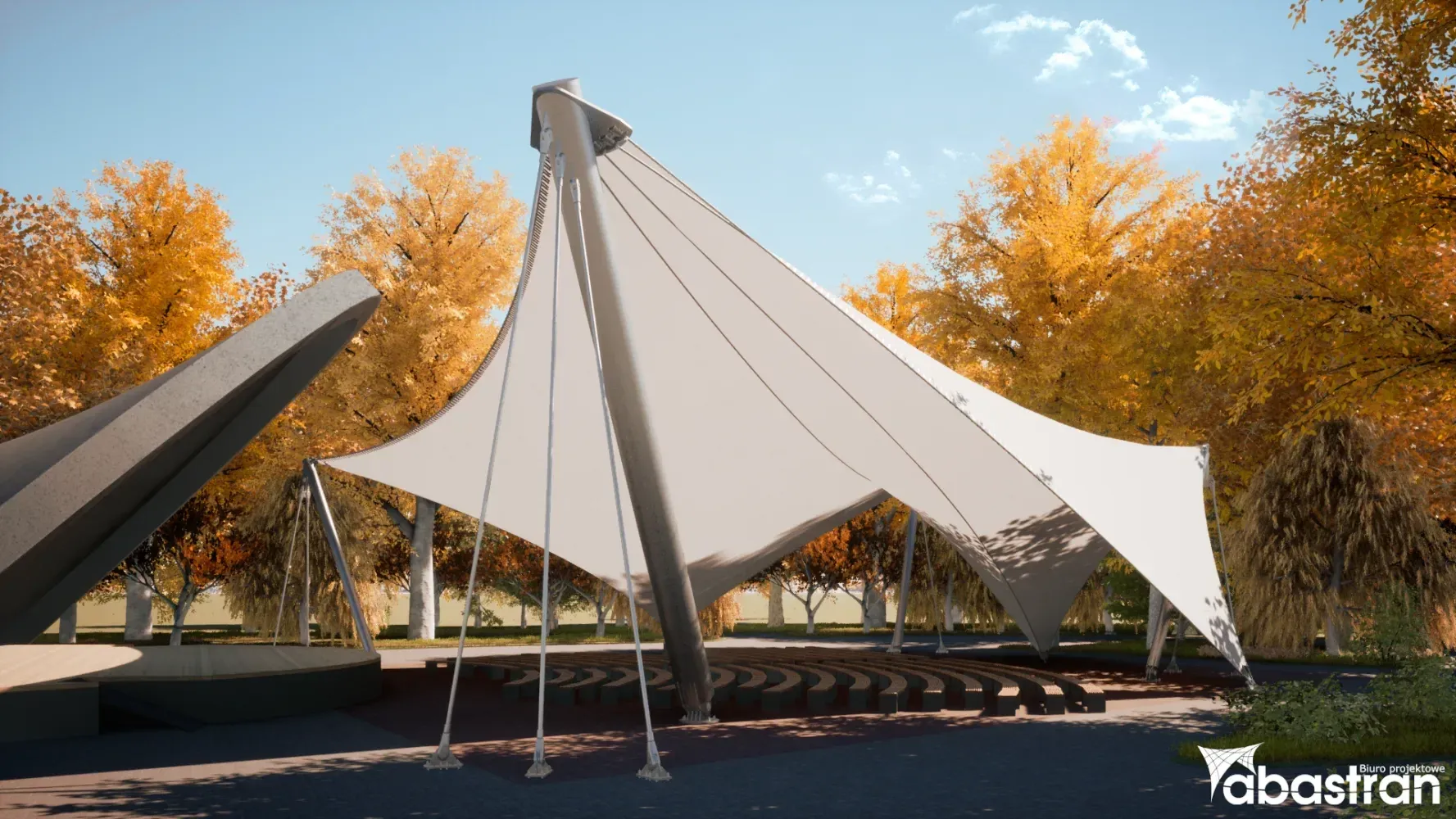
Modern architecture is moving steadily toward solutions that are lighter, more sustainable and more visually expressive than the rigid systems that dominated the twentieth century. Tensile membrane structures sit right in the middle of that shift. They are strong, light, fast to install, and they give architects a design vocabulary that nothing else offers. Here are ten specific reasons why membrane roofs keep winning the brief on serious projects.
What a tensile membrane roof actually is
A tensile membrane roof is a high-performance technical fabric — usually PVC-coated polyester, PTFE-coated fibreglass or ETFE foil — stretched into a doubly curved shape under controlled prestress. The fabric works in tension only, supported by a frame of steel masts, cables, or arches. The result is a structurally efficient envelope that uses an order of magnitude less material than an equivalent rigid roof.
That fundamental difference is what drives every advantage that follows.
The ten advantages
1. Lightness combined with mechanical strength
A typical PVC-coated polyester architectural membrane weighs 800–1500 g/m² but holds tensile strengths in the thousands of newtons per 5 cm. PTFE-coated fibreglass takes that even further. The result is a roof that covers stadiums and concert halls with a fraction of the dead load of any rigid alternative — which means smaller foundations, smaller frames, and less material everywhere.
2. Sculptural design freedom
Membranes form anticlastic (saddle-shaped) surfaces that follow the laws of structural physics, not the limits of right-angle fabrication. That gives architects the freedom to create iconic forms — the Munich Olympic Stadium, the Allianz Arena, the Denver International Airport — that would be impossible or absurdly expensive in concrete and steel. Modern form-finding software has made these geometries routine.
3. Fast installation through prefabrication
The vast majority of work happens in the workshop, not on site. Panels are CNC-cut and HF-welded into the final envelope before they leave the factory. On-site installation is mostly about lifting and tensioning — which can be measured in days for projects that would take months in rigid construction. Less site disruption, faster handover, lower contracting risk.
4. Weather resistance over decades
A premium PVC-coated polyester membrane with PVDF lacquer holds its properties for 20–30 years of full outdoor exposure. PTFE-coated fibreglass goes well beyond that — 30+ years of service is realistic. The fabric handles UV, rain, snow, hail and temperature swings without significant degradation, and the topcoat keeps the surface looking new.
5. Sustainability and carbon footprint
A membrane roof uses dramatically less material per square metre than a rigid roof, which directly reduces the embodied carbon of the project. Daylight transmission through PTFE or ETFE cuts artificial lighting demand. Some membrane materials are recyclable at end of life. And the lighter supporting structure cascades the savings through the rest of the building.
6. Cost effectiveness
Compared to the equivalent steel-and-glass or steel-and-panel solution, a membrane roof typically reaches a comparable architectural quality at a lower capital cost. The trade-off is in the operating cost — premium membranes still need cleaning and inspection — but for most large projects the lifecycle economics favour membranes by a clear margin.
7. Project flexibility
The same fabric that covers a 5 000 m² stadium roof can be used on a 50 m² terrace canopy. The technology scales gracefully across project sizes, supporting structures, and architectural ambitions. That makes membranes a genuinely versatile material for any architect working across multiple scales.
8. Low maintenance and long service life
Self-cleaning topcoats, no painting cycles, no rust, no rot. A well-installed membrane envelope needs an annual visual inspection and an occasional wash — that is the entire maintenance plan. Compared to a steel roof that needs repainting every decade, the operational savings add up fast.
9. Application range
Tensile membranes cover stages and amphitheatres, stadium grandstands, shopping centres, train stations, parking areas, playground canopies, and entrance porches. The same engineering vocabulary handles every category — what changes is scale, fabric grade and supporting structure.
10. Self-cleaning fabric surfaces
PTFE-coated fibreglass and PVDF-laquered PVC are both engineered to release dirt under rainfall. That keeps the surface looking fresh without operator intervention, which matters enormously on roofs where access is difficult or dangerous.
Should you specify a membrane roof?
For large clear spans, public buildings, sports facilities, and any project where light, weight, speed of construction or visual identity are critical to the brief — yes. For traditional pitched-roof buildings or projects where the lifecycle is measured in centuries, rigid construction is still the right answer. The interesting middle ground is where most modern projects sit, and that is where tensile membranes have steadily been winning the brief.
If you are weighing membrane against rigid roofing for a project, get in touch with Abastran — we will help you assess whether a membrane is the right answer and, if so, how to specify it properly.