
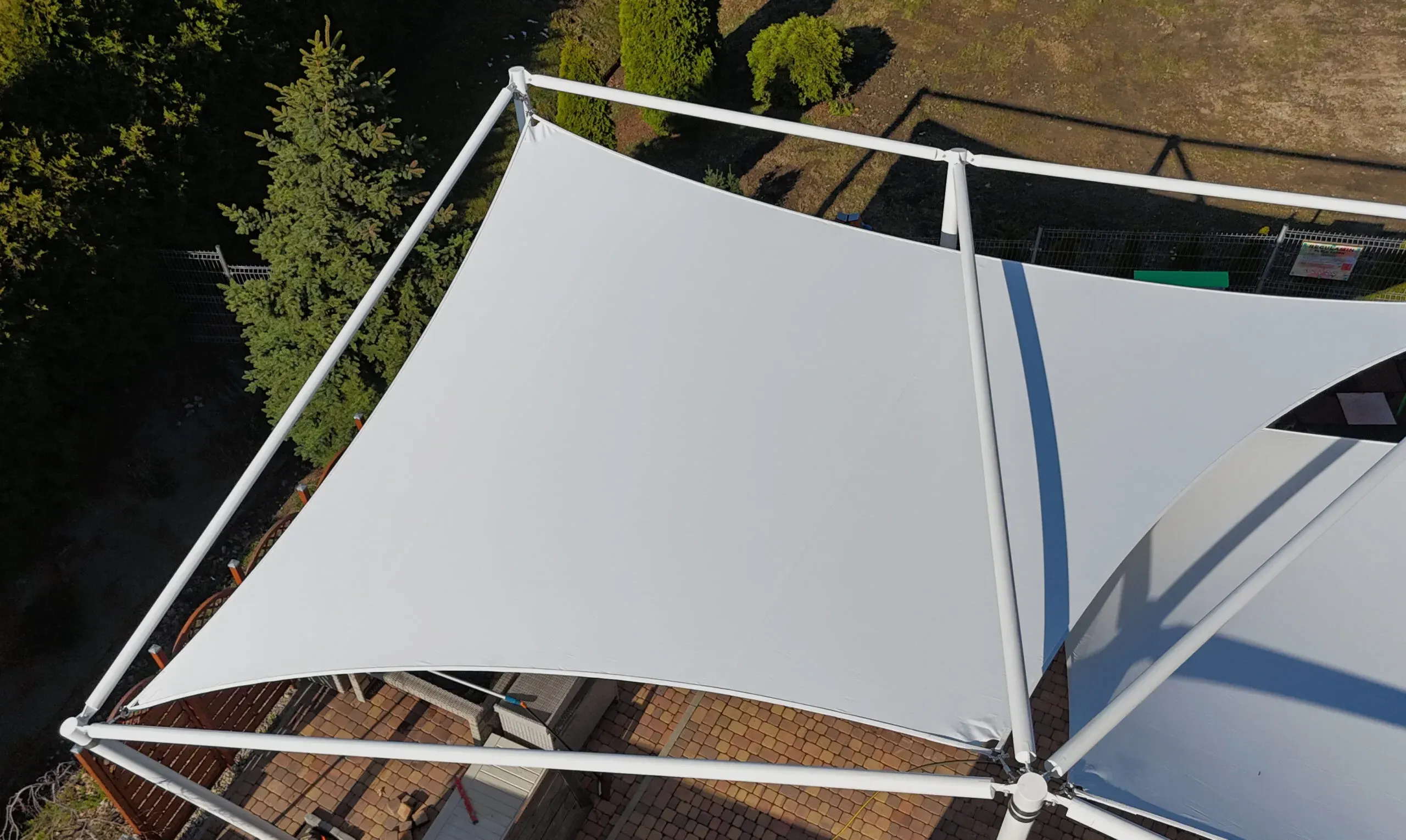
For any restaurant with a serious outdoor terrace, the choice of canopy is a commercial decision as much as an architectural one. Umbrellas and traditional awnings work in fair weather but fall short the moment conditions change. A tensile membrane canopy gives the terrace year-round usability — and that translates directly into longer trading hours, more covers per square metre, and a venue that works in every season.
Why umbrellas and awnings fall short
Traditional restaurant terrace covers are usually one of three things: market umbrellas, retractable awnings, or fixed pergolas. Each has its place, but each has clear limits.
Umbrellas cope with bright sun and a light shower. They struggle with anything heavier — rain runs off the edges in awkward places, the wind catches the canopy, and at some point staff have to take them down. Awnings handle sun beautifully but most retract entirely when it rains, leaving the terrace exposed. Fixed pergolas work better in mixed weather but still leak around the edges and rarely offer real protection from horizontal rain or wind.
The result is a terrace that only really works in good weather. For a restaurant, that means losing half the calendar to “the season”.
What a membrane canopy delivers
A tensile membrane canopy covers the terrace as a single continuous surface. The fabric is engineered to shed rain to designed drainage points. The doubly curved geometry catches very little wind. The supporting structure handles the loads, and the envelope keeps weather off the guests underneath — in any season.
Year-round usability
The defining advantage is that the terrace becomes part of the venue all year, not just from May to September. Add side glazing or windbreaks for the cold months, integrate radiant heaters under the canopy, and the same outdoor space hosts dinner service in February as easily as it does in July. For most restaurants this single change recovers months of trading.
Real weather protection
A correctly tensioned membrane sheds water reliably to designed drainage points. There are no wind gaps along the edges, no awkward seams that channel water onto guests, and no failures in heavy rain. UV is filtered by the fabric coating, so the terrace stays cool in midsummer and bright in shoulder seasons.
Custom design that fits the venue
Membrane canopies are made to measure. The shape, the colour, the drainage geometry and the supporting structure are all designed for the specific terrace they cover. A traditional inn gets a canopy that respects the historic façade. A modern bistro gets a sculptural form that reads as part of the brand. There is no off-the-shelf compromise.
Integrated lighting and heating
Because the canopy is a single engineered structure, it can incorporate LED lighting, radiant heaters, retractable side elements and sound systems from the outset. Guests get a space that feels designed, not improvised. Operators get a terrace that works without the usual stack of clip-on accessories.
What a real project looks like
A restaurant terrace canopy project typically runs through five steps:
- Site survey and brief. We measure the terrace, photograph the surroundings, and discuss how the venue uses the space across the seasons. Existing buildings, neighbouring properties and local planning rules all feed into the design.
- Design and visualisation. A 3D model of the canopy is generated and refined with the client. This is where architectural decisions get made — fabric colour, supporting structure style, lighting integration, side enclosures.
- Engineering and approvals. Structural calculations confirm wind and snow loads. Where local planning approval is needed, drawings are submitted and the design adapted as required.
- Fabrication. The fabric is CNC-cut and HF-welded in the workshop, the steel substructure is fabricated, and everything ships to site ready for installation.
- Installation. The substructure goes up first, then the membrane envelope is unfolded, lifted into position, and tensioned. Final commissioning checks fix the geometry to the design prestress.
The whole process from brief to opening night typically takes a few weeks for a standard restaurant terrace, considerably less than any rigid construction alternative.
Why membrane canopies are the right choice for restaurants
Commercial economics
A membrane canopy converts an outdoor terrace from a seasonal asset into a year-round one. For most restaurants the additional revenue from extended trading covers the capital cost within a small number of years.
Brand and identity
A well-designed canopy is a piece of architecture — visible from the street, photographed by guests, recognisable in social media. It does for a restaurant what a striking shopfront does, only better, because it shapes the experience of the whole terrace.
Long service life
Premium PVC architectural membrane covers last 20–30 years with minimal maintenance. That is far longer than any awning or umbrella product on the market.
Custom fit
Every project is designed for its specific site. There are no compromises with stock sizes or generic shapes — the canopy fits the terrace, the building and the brand exactly.
In summary
For any restaurant with a serious outdoor terrace, a membrane canopy is now the most practical and most attractive answer to the year-round trading question. It delivers real weather protection, custom design, long service life and economics that work for the business.
If you are running a restaurant and weighing a permanent canopy for your terrace, get in touch with Abastran — we will help you assess the site, propose a design and walk you through what the project would look like.